

The Explosive Rise of Digital Assets
Not too long ago, money was simple. You had coins in your pocket, paper bills in your wallet, maybe a few numbers in your bank account. Fast forward to today, and suddenly people are buying digital cats, sending money across borders in seconds, and arguing whether Bitcoin will outlive gold. This is the age of digital assets, and it’s nothing short of revolutionary.
But here’s the catch: when someone says “crypto,” they might mean Bitcoin, Ethereum, or Dogecoin. Another person might be talking about stablecoins, NFTs, or a governance token used to vote on DeFi protocols. The confusion is real, and that’s where the distinction between cryptocurrencies vs crypto tokens becomes crucial. Without this clarity, investors risk misjudging what they’re holding, developers may misunderstand the tools they’re building with, and everyday users could miss the bigger picture of Web3.
What Exactly Are Digital Assets?
At its core, a digital asset is any value that exists in digital form and can be owned or transferred. Think of them as the “online version” of value. They come in several flavors:
- Cryptocurrencies like Bitcoin or Litecoin, which run on their own blockchains and act as native currencies.
- Crypto tokens, built on top of existing blockchains, often serving specific purposes like powering apps or representing assets.
- Stablecoins, pegged to traditional currencies like the US dollar, giving the crypto world a bit of stability.
- NFTs (Non-Fungible Tokens), unique digital collectibles that turned pixelated apes into million-dollar assets.
- CBDCs (Central Bank Digital Currencies), government-backed digital versions of national money.
Each of these fits under the umbrella of digital assets, but they are not interchangeable. Just as you wouldn’t confuse a stock certificate with a dollar bill, it’s important not to confuse cryptocurrencies vs crypto tokens.
Why the Distinction Matters
Imagine you’re stepping into a car showroom. You see sleek sedans, rugged SUVs, and eco-friendly hybrids. They all fall under the category of “cars,” but each serves a very different purpose. That’s exactly how the world of digital assets works. Yes, Bitcoin and an NFT are both “crypto,” but their roles in the ecosystem are miles apart.
When people fail to distinguish cryptocurrencies vs crypto tokens, chaos follows. An investor might buy a utility token expecting it to rise like Bitcoin, only to realize it’s more like a ticket to a theme park than a piece of digital gold. A developer might try to use a cryptocurrency to power a dApp, when in reality, tokens are the better fit. And an everyday user sending remittances might end up paying more fees because they didn’t understand which asset was most efficient.
The Purpose of This Blog
That’s where this guide comes in. Our mission is simple: to draw a clear, practical line between cryptocurrencies vs crypto tokens. We’ll unpack what makes them similar, what sets them apart, and how each one plays a unique role in shaping the future of money and technology.
By the end, you won’t just be able to explain the difference to your friends—you’ll also understand how this difference impacts investments, business models, and even day-to-day usage. Because whether you’re parking your savings in Bitcoin, staking tokens in a DeFi project, or exploring the hype around NFTs, knowing exactly what you’re dealing with is the first step to making informed choices.
Why You Should Care
If you’re an investor, this distinction affects your portfolio’s risk and reward. If you’re a developer, it determines the building blocks of your project. And if you’re an everyday user, it influences how you send money, vote in a DAO, or even own a piece of digital art.
The Web3 economy doesn’t run on vague terms—it runs on clear distinctions. Cryptocurrencies vs crypto tokens is not just a semantic debate. It’s about understanding the infrastructure, purpose, and potential of digital assets so you don’t get lost in the jargon.
Think of it this way: you wouldn’t want to mistake a house deed for cash in your pocket. One lets you buy groceries, the other proves you own property. Both are valuable, but their value is realized in completely different ways. Similarly, knowing the difference between cryptocurrencies vs crypto tokens can be the difference between a smart decision and an expensive mistake.
The Web3 Journey
Let’s rewind to 2009. A mysterious figure named Satoshi Nakamoto introduced Bitcoin, the first cryptocurrency. It was meant to be peer-to-peer cash without banks. That was the spark. Soon after, Ethereum entered the scene and changed the game with tokens—suddenly, you could build apps, issue tokens, and represent anything from stocks to art on a blockchain.
From there, the ecosystem exploded. Stablecoins gave people a way to hold “crypto dollars.” NFTs turned memes and art into million-dollar assets. DAOs allowed communities to govern projects with votes powered by tokens. And today, governments are testing CBDCs to compete with private digital currencies.
This journey illustrates why the conversation around cryptocurrencies vs crypto tokens is not an academic one. It’s about tracing how the ecosystem has matured, diversified, and built new categories of digital value.
The Reader’s Relevance
So, where do you fit into all of this?
- If you’re saving in Bitcoin, you’re engaging with a cryptocurrency.
- If you’re trading Uniswap’s UNI or holding Chainlink’s LINK, you’re in the token space.
- If you’re experimenting with stablecoins or NFTs, you’re exploring specialized token categories.
Each choice has implications for risk, use case, and future growth. That’s why learning the difference between cryptocurrencies vs crypto tokens is not just useful—it’s essential.
The world of digital assets can feel like a maze, filled with jargon, hype, and endless innovation. But the foundation starts here: understanding what cryptocurrencies are, what crypto tokens are, and why the two should never be lumped together.
This is more than a beginner’s guide—it’s a roadmap for investors, developers, and curious minds navigating the Web3 economy. So, buckle up. We’re diving deep into the battle of cryptocurrencies vs crypto tokens, and by the end, you’ll see why this distinction could shape the future of finance, technology, and maybe even society itself.
Understanding the Basics
What Are Cryptocurrencies?
The Birth of Digital Money
Picture this: It’s 2009, the world is grappling with a financial crisis, and trust in banks is at an all-time low. Out of nowhere, a mysterious figure—or maybe a group—called Satoshi Nakamoto introduces Bitcoin. It wasn’t just another payment app or an online wallet. It was a whole new form of money—a cryptocurrency. Unlike dollars or euros, it didn’t need banks, middlemen, or even governments to function.
That’s the beauty of cryptocurrencies: they are native digital currencies operating on their own blockchain. Think of them like a sovereign nation, except instead of land and borders, they’re built on decentralized networks that no single entity controls. Bitcoin has its own blockchain. Litecoin has its own. Monero has its own. Each of these blockchains is like an independent country, minting and securing its own currency.
Core Features That Set Them Apart
The backbone of cryptocurrencies lies in three pillars:
- Decentralization: No single company or government can shut down Bitcoin. It runs on thousands of computers worldwide.
- Cryptographic Security: Transactions are locked with advanced math, making them nearly impossible to fake.
- Peer-to-Peer Transactions: You don’t need PayPal or Visa to send Litecoin to a friend in another country. You just send it directly.
These features make cryptocurrencies more than just digital cash. They are programmable, borderless, and censorship-resistant. That’s why enthusiasts often call them “freedom money.”
Real-World Examples
- Bitcoin (BTC): The pioneer, often called “digital gold,” valued for its scarcity and store-of-value properties.
- Litecoin (LTC): A faster, lighter version of Bitcoin, good for everyday payments.
- Monero (XMR): Focused on privacy, ensuring transactions are confidential and untraceable.
When you hold one of these, you’re not just holding numbers on a screen. You’re holding a piece of a global, decentralized network. That’s what makes cryptocurrencies so powerful in the debate of cryptocurrencies vs crypto tokens.
Their Primary Purpose
Cryptocurrencies serve three classic roles of money:
- Medium of Exchange – You can buy coffee with Bitcoin (if the café accepts it).
- Store of Value – People treat Bitcoin like digital gold, protecting against inflation.
- Unit of Account – In crypto-native ecosystems, prices are often quoted directly in coins like BTC or ETH.
Cryptocurrencies are designed to function like money, and their independence from existing systems makes them stand tall in the cryptocurrencies vs crypto tokens discussion.
What Are Crypto Tokens?
The Next Evolution
Fast forward a few years from Bitcoin’s birth. Ethereum arrives, and suddenly the game changes. Instead of just having a single native currency, Ethereum allowed anyone to create crypto tokens using its blockchain. These tokens didn’t need their own separate blockchain; they simply piggybacked on Ethereum’s infrastructure.
Think of Ethereum like an amusement park. The park itself is the blockchain, and each ride ticket is a token. You can use different tickets for different rides, but they all rely on the same park infrastructure. That’s the essence of tokens—they are digital assets built on top of an existing blockchain.
Core Features of Tokens
Tokens come with their own set of superpowers:
- Smart Contract-Based: Instead of being mined like Bitcoin, tokens are created using self-executing code called smart contracts.
- Dependence on Host Blockchain: A token like Uniswap’s UNI cannot survive without Ethereum, because Ethereum secures and validates its transactions.
- Customizable Purpose: Tokens can represent almost anything—access rights, shares of a company, stable currency, or even your favorite digital cat.
This flexibility makes tokens the Swiss army knife of the blockchain world. And when comparing cryptocurrencies vs crypto tokens, this adaptability is what gives tokens their edge in utility.
Popular Examples of Tokens
- Uniswap (UNI): A governance token that gives holders voting rights on protocol upgrades.
- Chainlink (LINK): Powers decentralized oracles, which bring real-world data into blockchain applications.
- Tether (USDT): A stablecoin pegged to the US dollar, widely used in trading and DeFi.
These are not “currencies” in the traditional sense. Instead, they serve specific functions within larger ecosystems. That’s why tokens often play supporting but crucial roles in Web3.
Their Primary Purpose
Tokens can wear many hats, each one depending on what they were designed for:
- Utility Tokens – Access services or products within a platform (e.g., using tokens to pay for decentralized storage).
- Governance Tokens – Allow holders to vote on proposals in decentralized autonomous organizations (DAOs).
- Asset Representation – Represent real-world items like stocks, bonds, or real estate in tokenized form.
- Stable Value – Stablecoins like USDT and USDC maintain steady prices, making them popular in volatile markets.
The variety of token roles is a big reason the debate of cryptocurrencies vs crypto tokens is so essential—tokens aren’t designed to replace money but to extend blockchain functionality.
The Core Difference
Imagine two siblings. The older one, cryptocurrencies, is like a pioneer who goes off to build their own house on untouched land. They lay bricks, set up plumbing, and create a home from scratch. That’s Bitcoin with its blockchain.
The younger sibling, crypto tokens, is more resourceful. Instead of building from zero, they rent space in an already thriving city. They use the city’s electricity, water, and roads, but decorate their apartment however they like. That’s UNI or LINK on Ethereum.
Both siblings live in the same family of digital assets, but their approach to existence couldn’t be more different. And that’s why understanding cryptocurrencies vs crypto tokens is like understanding the difference between being a landlord and being a tenant—both have value, but the dynamics are worlds apart.
The Basics
When we talk about cryptocurrencies vs crypto tokens, we’re really talking about two foundational blocks of the digital asset universe. Cryptocurrencies are the pioneers with their own territory, built for independence and financial sovereignty. Tokens are the innovators, thriving within existing ecosystems, designed to expand possibilities and utilities.
Both have their strengths, both come with risks, and both are shaping the Web3 economy in different ways. But without grasping these basics, it’s easy to get lost in the buzzwords.
Now that we’ve laid the foundation, the journey into digital assets becomes much clearer: cryptocurrencies give us money without borders, and tokens give us tools without limits. Together, they form the beating heart of the blockchain revolution.
Blockchain Infrastructure
Native Blockchain vs. Hosted Blockchain
Cryptocurrencies: Owning the Ground They Stand On
Imagine building a city from scratch. You buy the land, lay down the roads, install the power lines, and then start building houses. That’s exactly what cryptocurrencies do. They don’t rely on anyone else’s infrastructure—they own their entire ecosystem.
Take Bitcoin for instance. It operates on the Bitcoin blockchain, a network that exists solely to secure and transfer Bitcoin. Similarly, Litecoin has its own chain, designed for faster payments. These native blockchains are independent, sovereign, and fully responsible for their security, scalability, and governance.
In the debate of cryptocurrencies vs crypto tokens, this independence is a defining characteristic. Cryptocurrencies live on self-built foundations, which makes them more resilient but also harder to scale or upgrade quickly.
Tokens: Renting Space in an Existing City
Now flip the story. Instead of building a city from scratch, imagine moving into New York, renting an apartment, and plugging into water, electricity, and public transport that’s already there. That’s what tokens do. They operate on existing blockchains like Ethereum, BNB Chain, Polygon, or Avalanche.
A token like USDC doesn’t need to secure its own blockchain. Instead, it relies on Ethereum’s security and infrastructure to exist. A governance token like UNI can be created through a smart contract and immediately start functioning because Ethereum provides the roads, electricity, and city management.
This hosted model makes tokens faster to deploy and more flexible. In comparing cryptocurrencies vs crypto tokens, this difference in infrastructure is like the contrast between owning land and renting property—both work, but the responsibilities and benefits are very different.
Consensus Mechanisms
Proof of Work (PoW)
The original method, used by Bitcoin, where miners solve puzzles to validate transactions. It’s secure and battle-tested, but energy-intensive.
Proof of Stake (PoS)
Popular in newer blockchains like Ethereum 2.0 and Solana. Validators stake coins to secure the network, making it faster and eco-friendly compared to PoW.
Emerging Models
Newer systems like Delegated Proof of Stake (DPoS) on EOS or Avalanche’s consensus mechanism experiment with speed and scalability.
For cryptocurrencies, consensus is baked into their DNA—it’s part of running a native chain. For tokens, consensus isn’t their headache; they simply inherit the mechanism of their host blockchain. That’s another key difference when dissecting cryptocurrencies vs crypto tokens.
Security Implications
Native Chains
A cryptocurrency’s security depends entirely on the strength of its network. Bitcoin’s hashrate makes it nearly impossible to attack. Monero’s privacy features protect transaction details. The chain’s independence is both its biggest strength and its heaviest burden.
Hosted Tokens
Tokens piggyback on their host chain’s security. If Ethereum is strong, then ERC-20 tokens like LINK or USDT are safe. But if the host chain suffers an exploit or outage, tokens are collateral damage. Remember when Solana faced multiple network halts? Every token on Solana froze too.
The cryptocurrencies vs crypto tokens discussion isn’t just academic—it has real-world consequences when it comes to security and reliability.
Smart Contract Role in Hosted Blockchains
Tokens exist because of smart contracts. These self-executing codes are like vending machines—drop in an input, and they deliver an output without human interference.
For example, Uniswap’s UNI token is governed entirely by smart contracts. Its issuance, distribution, and governance all rely on Ethereum’s underlying rules. In contrast, cryptocurrencies like Bitcoin don’t need smart contracts just to exist; their blockchain already defines how coins are created and transferred.
This makes smart contracts the lifeblood of tokens. Without them, there would be no utility, no governance, no DeFi. And it’s this reliance that highlights yet another critical angle in cryptocurrencies vs crypto tokens.
Blockchain Scalability & Performance
Native Chains: Custom But Limited
Bitcoin processes about 7 transactions per second. That’s slow compared to Visa, but it’s stable, predictable, and extremely secure. Native blockchains often sacrifice speed for resilience.
Hosted Tokens: Dependent on the Host
Tokens scale as much—or as little—as their host allows. On Ethereum, token transactions sometimes get stuck in mempools because of high gas fees. But on faster hosts like Solana or Polygon, tokens can move at near-instant speeds.
So in cryptocurrencies vs crypto tokens, performance isn’t always about the asset itself but the chain it lives on.
Interoperability & Cross-Chain Functionality
A big trend in the blockchain world is making different chains talk to each other. Cryptocurrencies, with their native chains, often need bridges or wrapped versions to move across ecosystems. For instance, Bitcoin can’t just show up on Ethereum—you need Wrapped BTC (WBTC).
Tokens, however, are naturally more flexible. Many stablecoins like USDC are now multi-chain, available on Ethereum, Polygon, Avalanche, and more. This interoperability makes tokens crucial to DeFi, while cryptocurrencies remain the bedrock but less portable.
In the cryptocurrencies vs crypto tokens comparison, this portability gives tokens a unique advantage in Web3’s interconnected future.
Governance Differences
Native Blockchains
Governance here is usually protocol-level. Bitcoin has no CEO. Upgrades happen slowly, often through community debates and consensus among miners and developers.
Hosted Tokens
Governance is often DAO-driven. For example, UNI holders vote on changes to Uniswap. AAVE holders decide on risk parameters in lending pools. Tokens turn governance into a democratic experiment, where holders collectively steer the ship.
This contrast—slow, protocol-level governance versus rapid, DAO-based governance—shows just how distinct cryptocurrencies vs crypto tokens really are in shaping ecosystems.
Real-World Examples of Hosted Token Ecosystems
Ethereum Ecosystem
Ethereum is the king of hosted tokens. From DAI (a decentralized stablecoin), USDC (a centralized stablecoin), AAVE (lending protocol governance), to LINK (oracle services), the variety of tokens is staggering.
BNB Chain Ecosystem
BNB Chain is home to tokens like CAKE from PancakeSwap and XVS from Venus. Both rely on the chain’s infrastructure, and both are central to DeFi activity on BNB Chain.
Other Chains
- Polygon: Known for scalability, hosting gaming tokens and DeFi assets.
- Avalanche: Fast finality, ideal for DeFi projects.
- Solana: High throughput, though sometimes criticized for outages.
Every token here is tied to its host. And that reliance underscores why distinguishing cryptocurrencies vs crypto tokens is essential for anyone exploring these ecosystems.
At the heart of digital assets lies their foundation: blockchain infrastructure. Cryptocurrencies build their own homes, complete with walls, doors, and defenses. Tokens rent space in bigger cities, thriving on shared resources and flexible rules.
From consensus mechanisms to governance, from scalability to security, the way these assets live and breathe depends on their infrastructure. And it’s this difference that makes the cryptocurrencies vs crypto tokens conversation so important.
Because whether you’re holding Bitcoin as a long-term hedge or staking UNI to influence DeFi governance, understanding the backbone of where your assets live could be the difference between confidence and confusion in the ever-expanding world of Web3.
Types of Crypto Tokens
The Colorful World of Tokens
If cryptocurrencies are like the kings and queens ruling their own kingdoms, tokens are the diverse citizens who make the cities vibrant. They don’t just serve one purpose; they wear different hats—sometimes as utility tickets, sometimes as votes, sometimes even as pieces of art. In the grand debate of cryptocurrencies vs crypto tokens, this diversity is what makes tokens fascinating. Let’s take a walk through their world.
Utility Tokens: The Tickets of the Blockchain Carnival
What They Are
Think of utility tokens as entry passes. They’re not designed to make you rich overnight (though markets often try to spin them that way). Instead, they’re created to unlock services, features, or products within a blockchain ecosystem.
How They Work
When you hold a utility token, it’s like having a ticket to a concert—you get access to something special. For example:
- BAT (Basic Attention Token) rewards users for viewing ads and pays creators in the Brave browser ecosystem.
- GRT (The Graph Token) powers indexing and querying on blockchain data.
Without these tokens, the platforms can’t function properly. And in the ongoing dialogue of cryptocurrencies vs crypto tokens, utility tokens prove that tokens are more than just digital cash—they are tools for building ecosystems.
Twist
Imagine you’re at an amusement park. You can’t just walk onto a roller coaster. You need a ticket. Utility tokens are that ticket in the Web3 world. They don’t make you the owner of the park, but they guarantee you access to the ride.
Security Tokens: The Digital Share Certificates
What They Are
Now let’s shift gears. Unlike utility tokens, security tokens represent actual ownership. They’re digital versions of stocks, bonds, or real estate shares—regulated and tied to real-world value.
Why They Matter
Security tokens blur the lines between traditional finance and blockchain. They bring Wall Street onto the blockchain stage. For example, a real estate company could tokenize its properties, selling fractions of ownership through tokens. Investors gain access to assets that were once out of reach, and the company gains liquidity.
Regulation Factor
Because they represent ownership and potential profits, regulators treat them seriously. The SEC in the U.S., for example, applies securities law to them. This is where cryptocurrencies vs crypto tokens gets interesting: cryptocurrencies like Bitcoin are often classified as commodities, while security tokens fall under securities law.
Twist
Think of security tokens like digital deeds. Owning one is like having a framed certificate on your wall, except this certificate lives on the blockchain and can be traded 24/7.
Governance Tokens: The Blockchain Voting Cards
What They Are
In the decentralized world, there’s no CEO pulling strings. Instead, governance tokens give decision-making power to the community. These tokens are the ballots of Web3.
How They Work
If you hold governance tokens, you can propose or vote on changes in a protocol. Some famous examples include:
- COMP (Compound), where holders vote on lending and borrowing parameters.
- AAVE, where token holders steer the direction of one of the largest DeFi platforms.
Why It Matters
Governance tokens put power directly in the hands of users. Instead of relying on centralized executives, blockchain projects evolve based on community decisions. In the cryptocurrencies vs crypto tokens debate, governance tokens showcase the democratic spirit of tokens.
It’s like being a shareholder in a co-op housing society. Everyone with a stake gets to vote on whether to fix the roof, upgrade the elevator, or change the color of the building. Except here, the votes decide billion-dollar protocols.
Stablecoins: Anchors in a Stormy Sea
What They Are
Crypto is notorious for volatility. Prices can swing wildly in a single day. Enter stablecoins, designed to peg their value to something stable—usually the U.S. dollar, euro, or even commodities like gold.
Popular Examples
- USDC: Issued by Circle, backed by reserves of U.S. dollars.
- DAI: Decentralized and backed by collateralized crypto assets.
Why They Matter
Stablecoins act as bridges between traditional finance and crypto. Traders use them to move in and out of volatile assets quickly. Everyday users rely on them for payments without fearing that the value will tank overnight.
And in comparing cryptocurrencies vs crypto tokens, stablecoins prove how tokens can create stability where cryptocurrencies like Bitcoin and Ethereum often show turbulence.
Picture being on a stormy sea in a small boat. Every wave feels like it might capsize you. Then you spot a lighthouse and drop an anchor. That anchor is a stablecoin—it keeps you steady even when the market is tossing ships around.
Non-Fungible Tokens (NFTs): The One-of-a-Kind Digital Collectibles
What They Are
NFTs are tokens too, but with a twist—they’re unique. While one Bitcoin is always equal to another Bitcoin, one NFT can be completely different from another. They’re the collectible baseball cards, the rare paintings, and the signed sneakers of the digital world.
Examples in Action
- Digital Art: Beeple’s artwork sold for millions as an NFT.
- Gaming: Axie Infinity creatures exist as NFTs.
- Collectibles: Profile picture projects like Bored Ape Yacht Club became status symbols.
Why They Matter
NFTs opened the floodgates for creativity in the crypto space. They proved tokens aren’t just financial instruments—they can be cultural artifacts. In the grand picture of cryptocurrencies vs crypto tokens, NFTs show the imaginative, human side of tokens.
Imagine owning a painting by Picasso. No one else has the same brushstrokes, the same canvas, the same value. That’s what owning an NFT feels like—except instead of hanging it in your living room, it’s secured on the blockchain.
The universe of tokens is vast and diverse:
- Utility tokens give you access.
- Security tokens grant you ownership.
- Governance tokens offer you a voice.
- Stablecoins provide you stability.
- NFTs deliver uniqueness.
Each type of token adds a layer of functionality and imagination to the blockchain world. When people ask about cryptocurrencies vs crypto tokens, tokens always stand out for their versatility. While cryptocurrencies aim to be money or a store of value, tokens stretch the possibilities of what digital assets can do—whether it’s funding art, voting on financial systems, or creating new forms of ownership.
In short, tokens are not just add-ons to the blockchain story—they’re the creative force that keeps expanding what’s possible in Web3. And understanding these categories isn’t just about jargon; it’s about seeing how the digital future is being built, one token at a time.
Key Differences: Cryptocurrencies vs Crypto Tokens
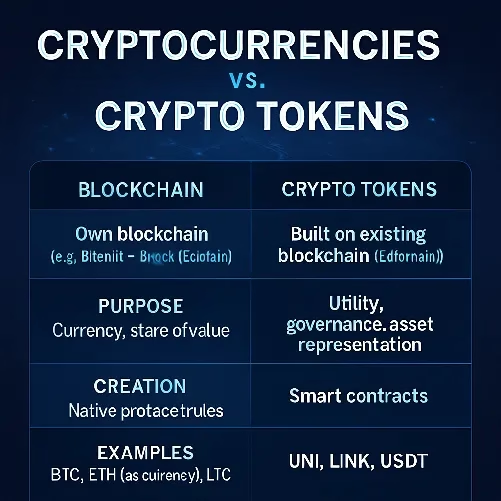
When people first step into the world of digital assets, they often get puzzled. “Aren’t cryptocurrencies and tokens the same thing?” someone might ask. On the surface, they both live on blockchains, both carry value, and both are traded on exchanges. But peel back the layers, and you’ll see that cryptocurrencies vs crypto tokens are more like apples and oranges—they belong to the same fruit basket, but each has its own identity, flavor, and use.
Let’s break down their differences with a simple table and then walk through each aspect with real-life examples and storytelling so that the concepts don’t just stay technical, but actually stick.
Comparison
| Aspect | Cryptocurrencies | Crypto Tokens |
|---|---|---|
| Blockchain | Have their own blockchain (e.g., Bitcoin → Bitcoin blockchain) | Built on top of an existing blockchain (e.g., UNI on Ethereum) |
| Creation | Issued by native blockchain protocol rules | Created through smart contracts |
| Purpose | Primarily used as currency, store of value, or settlement layer | Designed for utility, governance, asset representation, or stability |
| Examples | Bitcoin (BTC), Litecoin (LTC), Ethereum (as currency) | Uniswap (UNI), Chainlink (LINK), Tether (USDT) |
| Security | Secured by the native network’s consensus (PoW, PoS, etc.) | Secured by the host blockchain on which they live |
| Regulation | Often classified as commodities in many jurisdictions | Sometimes treated as securities under law, depending on use case |
Blockchain: The Land vs. the House
When we talk about cryptocurrencies vs crypto tokens, the first major difference lies in their home base—the blockchain itself.
Cryptocurrencies are like countries with their own sovereign land. Bitcoin has its own blockchain, and so does Ethereum. They have unique rules, miners or validators, and governance structures.
Tokens, on the other hand, are like houses built inside those countries. For example, the UNI token lives on the Ethereum blockchain, but it doesn’t have a blockchain of its own. Its existence depends on Ethereum’s infrastructure.
Imagine buying land in a city and then building your own house. The land itself (blockchain) is what makes the property unique. Cryptocurrencies own that land, while tokens are like apartment owners—they build on top of someone else’s foundation.
Creation: Protocol vs. Smart Contracts
Cryptocurrencies are born out of their blockchain’s protocol rules. Bitcoin follows its native code: every 10 minutes, miners validate blocks and new BTC is issued as a reward. It’s hardwired into the system.
Tokens, however, come to life through smart contracts. A developer can launch a token on Ethereum within minutes by writing a contract that defines how the token works, how many there are, and what purpose it serves.
This is why the cryptocurrencies vs crypto tokens distinction matters—cryptocurrencies need deep infrastructure to exist, while tokens can ride on that infrastructure like apps on an operating system.
Think of cryptocurrencies as national currencies printed by a central bank. Tokens, meanwhile, are like coupons or loyalty points that businesses can create on top of the existing money system.
Purpose: Currency vs. Functionality
Here’s where things get really interesting. Cryptocurrencies are primarily about money—they serve as digital cash, a store of value, or even “digital gold.” Bitcoin is used as a store of value; Litecoin for fast payments; Ethereum doubles as both currency and gas for powering its network.
Tokens expand beyond money. They can grant access to services (utility tokens), represent ownership (security tokens), let you vote in governance, or provide stability through pegs (stablecoins). The cryptocurrencies vs crypto tokens debate highlights this beautifully: cryptocurrencies are money, tokens are tools.
Picture walking into a theme park. You pay with money (cryptocurrency) to enter, but inside, you need tickets or wristbands (tokens) to ride attractions, buy food discounts, or vote on the next theme. The money gets you in, the tokens make the fun possible.
Examples: Familiar Faces
Examples clear the fog better than definitions.
- Cryptocurrencies: Bitcoin (BTC), the original digital currency. Ethereum (ETH), used both as currency and for network gas fees. Litecoin (LTC), created as the silver to Bitcoin’s gold.
- Tokens: Uniswap (UNI), used for governance in a decentralized exchange. Chainlink (LINK), powering smart contract oracles. Tether (USDT), a stablecoin pegged to the dollar.
When someone asks about cryptocurrencies vs crypto tokens, showing them examples instantly makes the difference tangible.
Security: Native Protection vs. Borrowed Protection
Security is the backbone of blockchain trust. Cryptocurrencies rely on their own networks for safety. Bitcoin uses Proof of Work (PoW), Ethereum now uses Proof of Stake (PoS). Their strength comes from the collective miners or validators.
Tokens don’t have independent security. They rely on the blockchain they’re built upon. If Ethereum is safe, UNI and LINK are safe. If Ethereum falters, the tokens on it face risks too.
Think of cryptocurrencies as independent castles with their own walls, guards, and moats. Tokens are like marketplaces inside those castles—they enjoy the castle’s protection, but they don’t have their own army.
Regulation: The Law’s Watchful Eye
This is where things get tricky. Cryptocurrencies like Bitcoin are often treated as commodities. Regulators compare them to gold or oil—assets with intrinsic value, not tied to a specific company.
Tokens, however, may fall into the category of securities depending on their function. A governance token or a utility token could be regulated if authorities see it as an investment contract. This makes cryptocurrencies vs crypto tokens not just a technical difference but a legal one with real consequences for investors and projects alike.
Imagine two types of assets: gold and company shares. Gold sits in its own category, regulated differently from corporate securities. Cryptocurrencies are like gold, while tokens are more like shares—subject to extra scrutiny.
Why These Differences Matter
Understanding cryptocurrencies vs crypto tokens isn’t just about passing a crypto quiz. It’s about real-world decisions. Investors need to know whether they’re buying into a blockchain’s backbone (like Bitcoin) or into a project that rides on another blockchain (like UNI). Developers must understand whether they’re building a full-fledged ecosystem or leveraging an existing one. Regulators, too, base their judgments on these distinctions.
Most importantly, everyday users should know why their stablecoin is stable, why their governance token lets them vote, or why their favorite NFT needs Ethereum’s security to even exist.
The divide between cryptocurrencies vs crypto tokens can be summed up like this:
- Cryptocurrencies are the bedrock—they own their land, set their rules, and secure their territory.
- Tokens are the builders and innovators—they live on top of these blockchains, experimenting with functions and utilities far beyond simple money.
Together, they form the twin pillars of the digital economy. One provides the foundation; the other fills it with life, color, and creativity. And for anyone exploring the crypto universe, recognizing this difference is like having a compass—it shows you exactly where you stand in a landscape that never stops evolving.
Use Cases of Cryptocurrencies vs Crypto Tokens
Every new technology finds its true value when it steps into real life. The same goes for digital assets. The debate of cryptocurrencies vs crypto tokens is not just a textbook discussion—it plays out in the way people send money home, protect their wealth, or even buy a digital collectible that represents a piece of art. Let’s take a closer look at how both cryptocurrencies and tokens are reshaping daily experiences, markets, and the way we think about value.
1 Use Cases of Cryptocurrencies
Digital Payments and Remittances
Think of the millions of workers who leave their countries to support their families back home. Traditional remittance services charge high fees, sometimes eating away 8–10% of the money being sent. Cryptocurrencies change this story. With Bitcoin or Litecoin, transactions can be done quickly and at a fraction of the cost.
Here, the cryptocurrencies vs crypto tokens line becomes clear: cryptocurrencies like Bitcoin serve directly as money. No need for intermediaries, no waiting days for clearance. It’s like skipping the long bank queues and simply pressing “send” to move value across borders.
Inflation Hedge and Store of Value
For people living in countries where inflation eats away savings—Argentina, Venezuela, Turkey—cryptocurrencies have become a digital lifeline. Bitcoin, often called “digital gold,” is used as a hedge against hyperinflation. While fiat currencies may lose 20% of their value in a few months, Bitcoin and other cryptocurrencies provide a chance to preserve wealth.
This shows one critical difference in cryptocurrencies vs crypto tokens: cryptocurrencies are often compared to hard money, something you can rely on when everything else loses its shine.
Cross-Border Transactions Without Intermediaries
If you’ve ever tried wiring money internationally, you know the pain—high fees, multiple banks in the chain, and delays. Cryptocurrencies like Ripple’s XRP and Stellar (XLM) solve this with near-instant cross-border transfers. They cut out middlemen, offering direct settlement between two parties anywhere in the world.
Here again, we see how cryptocurrencies vs crypto tokens play out. Cryptocurrencies focus on solving the “money movement” problem at its core. Tokens, which we’ll discuss shortly, build other functionalities on top of these rails.
2 Use Cases of Crypto Tokens
Access to Decentralized Applications (DApps)
Tokens are like the keys to different doors in the blockchain universe. For example, holding the Basic Attention Token (BAT) lets you participate in the Brave Browser ecosystem, rewarding you for your attention to ads. Similarly, AAVE tokens grant access to borrowing and lending features in DeFi.
In the cryptocurrencies vs crypto tokens comparison, this is where tokens shine—they unlock ecosystems. Cryptocurrencies may be the fuel, but tokens are the tickets that let you enjoy the rides.
Voting in DAO Governance
Imagine being a shareholder of a company and getting to decide its future direction. In the crypto world, governance tokens make this possible. For example, COMP holders vote on decisions about the Compound protocol, while UNI holders shape Uniswap’s future.
This is not something cryptocurrencies typically do. When we think of cryptocurrencies vs crypto tokens, governance is where tokens step into their own spotlight, giving communities power in a truly decentralized way.
Representing Real-World Assets
One of the most exciting applications of tokens is asset tokenization. Imagine owning a fraction of a skyscraper in New York or a piece of land in Dubai, all through a token. Security tokens make this real by representing ownership in tangible assets.
Here, the cryptocurrencies vs crypto tokens debate feels like comparing cash to stock certificates. Cash (cryptocurrency) is money, while tokens can act like shares, bonds, or deeds—bringing real-world assets onto blockchains.
Stable Value Transfers (Stablecoins in DeFi)
Stablecoins are the unsung heroes of decentralized finance. Tokens like USDT, USDC, and DAI are pegged to the US dollar, making them stable stores of value. They allow traders and everyday users to transact without worrying about extreme volatility.
In DeFi platforms, stablecoins act like the glue holding everything together—whether it’s lending, borrowing, or yield farming. When people ask about cryptocurrencies vs crypto tokens, stablecoins make the distinction obvious: cryptocurrencies like Bitcoin fluctuate wildly, while stablecoins offer predictability inside the blockchain space.
The Traveler’s Tale
Picture a young professional, Aarav, who lives in India and works remotely for a US-based company. His salary is paid in USDC, a token pegged to the dollar. He converts some of it into Bitcoin as a long-term hedge, keeps a portion in stablecoins for monthly expenses, and uses tokens like AAVE to earn passive income.
Aarav’s story captures the essence of cryptocurrencies vs crypto tokens in action. The cryptocurrency (Bitcoin) serves as a long-term store of value, while the tokens (USDC, AAVE) handle utility and stability. Both coexist in his financial toolkit, complementing each other instead of competing.
Why These Use Cases Matter
At this point, it’s clear that the cryptocurrencies vs crypto tokens divide isn’t about one being better than the other. It’s about roles. Cryptocurrencies act as the backbone of digital money, powering fast payments, wealth protection, and borderless transfers. Tokens, meanwhile, expand blockchain’s functionality—unlocking governance rights, stable transfers, asset tokenization, and access to new digital services.
Together, they create a full spectrum of possibilities. Without cryptocurrencies, there would be no secure foundation of decentralized money. Without tokens, we’d miss out on the creativity and innovation that make Web3 vibrant and user-driven.
When you look at the use cases of cryptocurrencies vs crypto tokens, the contrast becomes a symphony rather than a battle. Cryptocurrencies give us the promise of a new financial foundation: decentralized, borderless, and resistant to inflation. Tokens, on the other hand, bring colors and flavors to that foundation, enabling applications, governance, and real-world integration.
It’s not about choosing between cryptocurrencies or tokens—it’s about understanding how both fit into your life, your portfolio, or your business idea. If cryptocurrencies are the highways of the digital economy, tokens are the vehicles, shops, and services that make those highways worth traveling. And that’s why learning the differences isn’t just academic—it’s practical wisdom for anyone who wants to thrive in the future of finance.
Creation and Distribution of Cryptocurrencies vs Crypto Tokens
Every digital asset has a birth story. Some are forged in the relentless fire of mining rigs, others are quietly minted through lines of code and distributed in flashy public sales. To truly grasp the cryptocurrencies vs crypto tokens divide, you need to understand how each of these digital players comes into existence and spreads through the ecosystem. It’s a fascinating tale—part economics, part technology, and part community building.
How Cryptocurrencies Come to Life
Mining: The Original Birth Method
Bitcoin introduced the world to mining, and it remains the most iconic creation method. Mining is the digital equivalent of gold digging, except instead of pickaxes, miners use high-powered computers. They solve cryptographic puzzles, validate transactions, and, in return, earn new coins.
In the cryptocurrencies vs crypto tokens debate, mining highlights one key difference: cryptocurrencies often require immense energy, infrastructure, and computational power for their creation. Tokens, on the other hand, don’t need miners—they’re simply written into existence on a host blockchain.
Staking: A Greener Alternative
With Proof of Stake (PoS), coins are created by locking existing ones as collateral. Ethereum’s shift from Proof of Work to Proof of Stake changed the creation game. Validators secure the network by staking ETH and, in return, earn rewards.
This staking model shows another clear aspect of cryptocurrencies vs crypto tokens: cryptocurrencies are often tightly tied to the health and security of their own blockchains. The more people stake, the more secure the network becomes.
Genesis Block: The Legendary Beginning
Every cryptocurrency starts with a genesis block—the very first block on its blockchain. Bitcoin’s genesis block was mined in 2009, containing a hidden message about the financial crisis. It was more than code—it was philosophy.
Genesis blocks remind us that cryptocurrencies vs crypto tokens don’t just differ in technology but also in their origin stories. Cryptocurrencies often start with a moment of vision, while tokens can be spun up quickly by anyone with technical know-how.
How Tokens Enter the World
ICOs: The Early Boom Days
Initial Coin Offerings (ICOs) were the wild west of crypto fundraising. A team would publish a whitepaper, launch a token on Ethereum, and sell it to the public. For early investors, this felt like getting shares in the next Apple—only with fewer regulations.
ICOs underline the cryptocurrencies vs crypto tokens difference in distribution. Tokens are often sold or distributed before their ecosystem is fully functional, while cryptocurrencies like Bitcoin were earned through mining.
IDOs: The Decentralized Evolution
Initial DEX Offerings (IDOs) refined the ICO model by leveraging decentralized exchanges. Here, tokens are listed directly on platforms like Uniswap or PancakeSwap, making them accessible without centralized gatekeepers.
When people compare cryptocurrencies vs crypto tokens, IDOs highlight the agility of tokens—they can be distributed fast, globally, and without middlemen.
Airdrops: Free Distribution with Purpose
Tokens also make their way into wallets via airdrops. Projects send free tokens to early users or loyal supporters. It’s a marketing strategy, but also a way to decentralize ownership.
In the cryptocurrencies vs crypto tokens landscape, airdrops remind us that tokens often double as community-building tools, while cryptocurrencies usually rely on mining or staking rewards for distribution.
Liquidity Mining: Earning by Providing Liquidity
In DeFi, users can lock up assets in liquidity pools and, in return, earn tokens. For example, providing ETH and USDC in a Uniswap pool might earn you UNI tokens.
This model demonstrates how tokens blend utility with distribution. Unlike cryptocurrencies that are mined or staked, tokens often reward active participation in ecosystems.
Smart Contract Standards: The Framework Behind Tokens
Tokens thrive on standardization. Smart contract frameworks make sure they play nicely with wallets, exchanges, and apps.
ERC-20: The King of Fungible Tokens
ERC-20 is the most popular Ethereum standard for fungible tokens—those that are interchangeable like dollars. USDT, LINK, and UNI all follow this model.
ERC-721: The Birth of NFTs
ERC-721 introduced non-fungible tokens, each unique and indivisible. This standard gave rise to NFTs like CryptoPunks and Bored Apes.
BEP-20 and Others
On Binance Smart Chain, BEP-20 mirrors ERC-20, powering a wave of DeFi tokens. Similarly, Polygon, Avalanche, and Solana have their own token standards.
The importance here in cryptocurrencies vs crypto tokens is stark: cryptocurrencies don’t follow token standards because they are the base chain. Tokens rely on these frameworks to function across ecosystems.
The Tale of Two Births
Imagine two friends—Arjun and Neha. Arjun decides to build a house on his own land. He lays the foundation, constructs the walls, and invests years into making it stand tall. That’s like a cryptocurrency—born from scratch, with its own blockchain and rules.
Neha, on the other hand, rents a piece of land in a bustling city and builds a shop. She doesn’t need to worry about creating the land itself—she simply uses what’s already there. That’s like a token—built on an existing blockchain, easier to set up, but still valuable depending on what she sells.
This analogy captures the heart of cryptocurrencies vs crypto tokens creation and distribution. One requires foundational building, the other leverages existing foundations.
Why Creation and Distribution Matter
The way an asset is created affects its credibility, security, and even long-term survival. Cryptocurrencies like Bitcoin gain strength from their mining history and decentralized distribution. Tokens, however, succeed or fail based on community adoption, fundraising strategy, and how fairly they’re distributed.
For investors, understanding cryptocurrencies vs crypto tokens at this level helps in decision-making. A mined cryptocurrency may represent strong, battle-tested decentralization. A token launched via ICO may carry higher risk but also higher innovation potential.
The creation and distribution of digital assets reveal one of the clearest contrasts in cryptocurrencies vs crypto tokens. Cryptocurrencies are born from their own blockchains, nurtured by mining, staking, and the legendary genesis block. Tokens, in contrast, emerge through smart contracts, ICOs, IDOs, airdrops, and liquidity mining.
Both birth stories are valid. One emphasizes deep infrastructure and security; the other emphasizes flexibility, community, and rapid growth. Together, they form a dynamic ecosystem where digital money and digital utilities coexist—each with a creation tale that shapes its destiny.
Regulatory Landscape of Cryptocurrencies vs Crypto Tokens
When it comes to money, governments rarely stay silent. If there’s one thing regulators love, it’s rules—and the rise of digital assets has thrown them into a whirlwind. The tug-of-war between innovation and regulation is shaping the destiny of both cryptocurrencies and crypto tokens. To truly understand cryptocurrencies vs crypto tokens, we need to step into the courtroom, the parliament hall, and the regulators’ offices where these battles are being fought.
Global Overview of Regulation
United States: The SEC and Beyond
In the U.S., the Securities and Exchange Commission (SEC) plays a starring role. The SEC has been crystal clear on one thing: many tokens fall under securities law, especially those sold in ICOs or IDOs. Think of Ripple’s long-running case with XRP—it’s the classic example of regulators testing whether a token is a security.
Cryptocurrencies like Bitcoin, however, are mostly treated as commodities under the oversight of the Commodity Futures Trading Commission (CFTC). This distinction adds fuel to the cryptocurrencies vs crypto tokens debate: the same government views one as digital property and the other as a potential unregistered security.
Europe: ESMA and MiCA
In the European Union, the European Securities and Markets Authority (ESMA) and the new Markets in Crypto Assets (MiCA) framework are reshaping the rules. MiCA aims to create a uniform standard across all EU countries. Stablecoins, utility tokens, and crypto service providers will all have clear guidelines to follow.
Here, the divide of cryptocurrencies vs crypto tokens is codified into law—cryptocurrencies like Bitcoin are often treated as digital property, while tokens, especially stablecoins, face stricter rules due to their systemic risks.
India: RBI and SEBI’s Watchful Eye
In India, the Reserve Bank of India (RBI) has historically been cautious, even hostile, toward cryptocurrencies. At one point, banks were barred from working with crypto exchanges. Meanwhile, the Securities and Exchange Board of India (SEBI) is expected to play a key role in regulating tokens that behave like securities.
This reflects the uncertainty of cryptocurrencies vs crypto tokens in emerging markets: are they a threat, an opportunity, or something in between? India is still sketching its answers, but the approach is gradually shifting from outright bans to structured oversight.
Cryptocurrencies Under Regulation
Classified as Commodities or Property
Most regulators treat cryptocurrencies like Bitcoin and Litecoin as commodities or property. This classification means they are not tied to any central issuer and function more like natural resources. You can mine them, you can own them, and you can trade them.
In the cryptocurrencies vs crypto tokens debate, this gives cryptocurrencies a certain stability. They may not be legal tender, but they are recognized as tradable, taxable assets in many countries. For investors, this means clarity: capital gains taxes usually apply, and exchanges often fall under anti-money laundering (AML) and know-your-customer (KYC) rules.
Regulatory Benefits and Limits
By treating cryptocurrencies as property, regulators avoid having to apply securities law, which could stifle innovation. However, this doesn’t mean they are free from scrutiny. From money laundering to terrorist financing, regulators demand transparency in cryptocurrency transactions.
Tokens Under Regulation
Utility vs. Security Classification
Tokens face a more complicated regulatory path. A utility token like BAT, designed to access a specific service, might be spared from strict oversight. A security token, however, is another story—it represents ownership in an asset or company and must comply with securities law.
This gray area makes the cryptocurrencies vs crypto tokens discussion more urgent. A token project can succeed or collapse depending on whether regulators classify it as a security. Projects that skip compliance risk lawsuits, bans, or being delisted from exchanges.
Compliance Requirements
Security tokens often need to register with regulators, disclose information to investors, and follow trading restrictions. Even governance tokens can fall into this bucket if regulators see them as investment contracts.
For developers, this means careful planning. When launching a token, you can’t just think about code and community—you need a legal strategy too.
Impact on Investors
For investors, the regulatory landscape is like the weather: it affects everything from mood to decisions. In the U.S., holding Bitcoin may feel safe because it’s widely accepted as a commodity. But investing in a new governance token can feel risky if there’s a chance the SEC will later label it a security.
The cryptocurrencies vs crypto tokens distinction here is crucial. Cryptocurrencies give investors a clearer legal environment, while tokens often carry hidden regulatory risks.
Investors also face tax implications. In many countries, swapping one token for another is a taxable event. Even receiving free airdropped tokens can trigger tax liabilities. That’s why savvy investors not only study whitepapers but also stay updated on the tax codes of their countries.
Impact on Developers
For developers, the regulatory landscape is like building a castle while the government decides whether it should be taxed as a fort, a palace, or a casino.
If you’re creating a cryptocurrency, your main focus is infrastructure and consensus. Regulation is relatively straightforward: AML/KYC compliance and exchange registration. But if you’re creating a token, the situation gets trickier. You need to worry about securities law, investor protection, and whether your governance model could be seen as profit-sharing.
This shapes innovation. Some developers avoid jurisdictions with strict rules, moving projects to crypto-friendly nations like Switzerland, Singapore, or the UAE. The cryptocurrencies vs crypto tokens debate, therefore, doesn’t just affect theory—it determines where talent and capital flow.
The Restaurant Analogy
Imagine cryptocurrencies as raw ingredients—like rice or wheat. Regulators treat them like commodities: valuable, tradable, and subject to basic rules. Tokens, however, are like dishes prepared in a restaurant. Depending on how they’re cooked, plated, and marketed, they might fall under food safety regulations, health codes, or even intellectual property rules.
This analogy captures the heart of cryptocurrencies vs crypto tokens under regulation. Cryptocurrencies are seen as raw resources, while tokens, being human-made recipes, invite closer scrutiny.
The regulatory landscape of cryptocurrencies vs crypto tokens is still evolving, and in many ways, it mirrors the early days of the internet when lawmakers were scrambling to apply old rules to new realities.
- Cryptocurrencies are often treated as commodities or property, giving them a more stable legal footing.
- Tokens face the constant challenge of classification—utility or security—with compliance requirements that can make or break a project.
- Investors must navigate taxes, legal risks, and compliance traps.
- Developers must balance innovation with legal caution.
In short, regulation doesn’t kill innovation—but it shapes it. And in the case of cryptocurrencies vs crypto tokens, understanding the legal map is as important as understanding the technology itself. Without this knowledge, stepping into the digital asset space is like sailing without a compass in waters where the rules of the sea change with every wave.
Risks and Challenges in Cryptocurrencies vs Crypto Tokens
Every shiny coin has two sides, and the world of digital assets is no different. While the promise of decentralization, transparency, and wealth creation excites millions, the path is not without pitfalls. Anyone navigating the maze of cryptocurrencies vs crypto tokens soon realizes that opportunities walk hand in hand with risks and challenges. From stomach-turning volatility to ever-changing laws, here’s a closer look at the darker but essential side of this industry.
Volatility: The Double-Edged Sword
If there’s one thing that defines the crypto space, it’s volatility. Prices of cryptocurrencies like Bitcoin can rise by 20% in a day and crash by the same margin the next. Tokens, tied to hosted blockchains, can be even more fragile—sometimes gaining massive hype during launches, only to nosedive after the buzz fades.
In the cryptocurrencies vs crypto tokens debate, volatility is a common thread but with different flavors. Cryptocurrencies often swing based on macroeconomic factors—like inflation, government policies, or global adoption trends. Tokens, however, tend to be influenced by project-specific news, such as a smart contract update or a new governance vote.
For everyday investors, this roller-coaster ride can be thrilling or terrifying. Some compare it to riding a bull in a rodeo—if you can stay on long enough, you might win big, but the risk of being thrown off is ever-present.
Security Risks: Hacks and Smart Contract Bugs
The digital nature of both cryptocurrencies and crypto tokens makes them attractive targets for hackers. Exchanges have been drained of billions, wallets have been compromised, and tokens have disappeared overnight in rug pulls.
Cryptocurrencies rely heavily on the security of their native blockchain. Bitcoin, for instance, has proven resilient due to its decentralized network and massive hash power. Tokens, however, bring in new risks—smart contract bugs. A single line of faulty code can open the floodgates for hackers, as seen in famous incidents like the DAO hack on Ethereum.
This is where cryptocurrencies vs crypto tokens again show their divide. Cryptocurrencies benefit from robust, time-tested networks, while tokens rely on the trustworthiness of their developers and the security of their host blockchain. One careless coding error can wipe out millions of dollars, teaching investors the hard way that “trustless systems” still require trust in code quality.
Regulatory Uncertainty: The Shifting Ground
Regulation is like the weather—unpredictable and constantly changing. For cryptocurrencies, many countries treat them as property or commodities, but they are not always recognized as legal tender. Tokens face even more complicated classifications. Utility tokens might escape strict scrutiny, but security tokens fall directly under securities law, making compliance a must.
The uncertainty in cryptocurrencies vs crypto tokens leaves both investors and developers in limbo. Imagine building a house while the government is still deciding whether houses in your area are legal. That’s how many token projects feel.
For investors, this creates anxiety. A token that looks promising today may be deemed an unregistered security tomorrow, causing exchanges to delist it and wiping out value. Cryptocurrencies enjoy relatively clearer treatment, but even they face sudden changes, such as China’s repeated crackdowns or India’s fluctuating stance.
Scams and Fraud: Wolves in Digital Clothing
The anonymous, decentralized world of crypto has unfortunately become a breeding ground for scams. Pump-and-dump schemes, where a group hypes a token only to sell at the peak and leave latecomers with worthless assets, remain common. Fake ICOs have lured investors with flashy websites, only to disappear overnight with millions.
Here’s where cryptocurrencies vs crypto tokens matter again. Cryptocurrencies, especially established ones like Bitcoin and Ethereum, are harder to manipulate at scale. Tokens, however, are fertile ground for fraudsters because they are easier to create and market. A simple smart contract on Ethereum can launch a token in minutes, and with clever marketing, unsuspecting investors can be tricked into buying it.
The lack of investor protection magnifies the problem. Unlike traditional finance, there’s often no insurance or recourse when things go wrong. Once funds are gone, they are usually gone forever.
The Human Side of the Risks
To understand the emotional side, imagine Ramesh, a young professional who bought Bitcoin in 2020. He watched its price surge and felt invincible—until the next crash wiped out half his savings. Meanwhile, his friend Meera invested in a new governance token, drawn by the promise of high yields. Unfortunately, the token’s smart contract had a bug, and the project collapsed overnight.
These stories are not rare. They’re daily realities in the world of cryptocurrencies vs crypto tokens. For some, the losses teach caution. For others, they end participation altogether.
Balancing Risks with Opportunities
Despite these challenges, the industry keeps growing. Why? Because alongside volatility, there’s potential for high returns. Alongside hacks, there are innovations in security. Alongside scams, there are legitimate projects building the future of finance.
Understanding the risks of cryptocurrencies vs crypto tokens doesn’t mean avoiding them altogether. It means entering with eyes open, armed with research, caution, and a realistic mindset. Volatility can be managed with risk strategies. Security risks can be mitigated by using trusted wallets and exchanges. Regulatory uncertainty can be navigated by keeping up with legal developments. And scams can often be avoided through due diligence and skepticism.
The risks and challenges of cryptocurrencies vs crypto tokens remind us of one truth: there’s no reward without risk. These digital assets are powerful tools, but they require responsibility, awareness, and resilience.
- Volatility makes prices unpredictable but also opens doors to big opportunities.
- Security risks remind us that even decentralized systems depend on human-built code.
- Regulatory uncertainty highlights the gap between innovation and law.
- Scams and fraud show that greed and fear are timeless vulnerabilities.
For investors and developers alike, success in this space isn’t just about chasing profits. It’s about respecting the risks, learning from mistakes, and building with integrity. The crypto world may be turbulent, but those who understand the pitfalls of cryptocurrencies vs crypto tokens are far better equipped to survive—and even thrive—through its storms.
Investment Considerations in Cryptocurrencies vs Crypto Tokens
Stepping into the world of digital assets can feel like walking into a bustling bazaar. Everywhere you turn, there are dazzling signs, persuasive sellers, and promises of treasures waiting to be discovered. But just as in any marketplace, not everything that glitters is gold. When it comes to cryptocurrencies vs crypto tokens, making smart investment decisions requires a careful eye and a disciplined mind. Let’s break down the key considerations that separate reckless gambling from strategic investing.
Liquidity and Market Depth
One of the first things any serious investor must check is liquidity. Imagine trying to sell your land in a deserted village—no matter how valuable it is, without buyers, you’re stuck. The same goes for digital assets.
Cryptocurrencies like Bitcoin and Ethereum generally enjoy deep liquidity, meaning you can buy or sell large amounts without drastically moving the market price. This stability is crucial for investors who want flexibility. Tokens, however, often depend on their ecosystem and exchange listings. Some tokens may have enormous potential but limited trading pairs or low daily volumes, making it difficult to exit without slippage.
This difference highlights why cryptocurrencies vs crypto tokens is more than a technical debate—it directly affects investor experience. High liquidity brings confidence, while low liquidity can trap investors, especially during market downturns when everyone is rushing for the exit.
Long-Term Viability of the Project
When considering investments, the shiny short-term profits often overshadow the real question: will this asset still be valuable in five or ten years?
Cryptocurrencies have an advantage here. Their purpose as money or a store of value is universal, giving them durability. Bitcoin, with its capped supply of 21 million coins, has proven its staying power as “digital gold.” Tokens, on the other hand, live or die by the success of their project. A governance token tied to a DeFi platform thrives only as long as the platform remains relevant. If the project fades, so does the token’s value.
This is why in the cryptocurrencies vs crypto tokens debate, long-term viability leans heavily on the project’s roadmap, leadership, and adaptability. Investors who only chase hype without evaluating fundamentals often learn hard lessons when the excitement fades.
Tokenomics: The Invisible Engine
Behind every digital asset is an economic engine called tokenomics. It determines supply, demand, and incentives within the system. A poorly designed token economy can sink a project faster than bad marketing.
For cryptocurrencies, tokenomics is usually straightforward. Bitcoin’s halving events, for example, reduce supply over time, creating scarcity and potentially driving value upward. Tokens, however, can be more complex. Factors like total supply, burn mechanisms, inflation rates, staking rewards, and utility within the ecosystem all play a role.
Take stablecoins as an example. Their value lies not in scarcity but in stability, pegged to a fiat currency. Governance tokens may incentivize participation with rewards, while utility tokens depend on being used within decentralized applications. The way tokenomics is designed often determines whether a token becomes sustainable or collapses under its own weight.
Understanding these mechanics is vital when evaluating cryptocurrencies vs crypto tokens. Tokenomics can make or break investor confidence. A project promising infinite token issuance without real demand is like a leaking boat—no matter how big, it will eventually sink.
Due Diligence: Reading Between the Lines
This is where many investors stumble. In the excitement of quick profits, they skip the homework. But due diligence separates informed investors from speculative gamblers.
Start with the whitepaper. Does it explain the project clearly, or is it just filled with buzzwords? A strong whitepaper outlines the problem, the solution, token utility, roadmap, and governance structure. Then look at the team. Are they experienced professionals with verifiable track records, or anonymous developers hiding behind avatars?
Community strength also matters. In the decentralized world, an engaged and loyal community often drives adoption and resilience. Just look at Dogecoin—a project that began as a joke but gained value because of a passionate community. On the flip side, many tokens with big promises but no real supporters have faded into obscurity.
In the discussion of cryptocurrencies vs crypto tokens, due diligence becomes even more important for tokens. Cryptocurrencies like Bitcoin already have years of history and widespread recognition, but tokens vary widely in credibility. Without proper research, investors risk falling into traps set by rug pulls, fake partnerships, or unrealistic promises.
The Human Side of Investment Choices
To put this into perspective, imagine Arjun, a young investor who bought Bitcoin because he believed in its scarcity and long-term adoption. He didn’t panic during short-term dips, and over the years, his patience paid off. Meanwhile, his cousin Priya rushed into every new token launch she came across on social media. Some doubled overnight, but most ended up worthless. Priya realized too late that hype is not a substitute for fundamentals.
These personal stories reflect the essence of cryptocurrencies vs crypto tokens. One offers stability and proven resilience, while the other offers variety and innovation—but with added risk. The smart investor knows when to balance both.
Investment in digital assets is not just about chasing numbers; it’s about evaluating real-world factors that drive value. The road is full of distractions, but focusing on liquidity, long-term viability, tokenomics, and due diligence can protect investors from costly mistakes.
- Liquidity determines whether you can buy or sell with ease.
- Long-term viability ensures your asset doesn’t become irrelevant.
- Tokenomics reveals whether the project is sustainable or doomed.
- Due diligence separates authentic projects from scams.
Ultimately, the debate of cryptocurrencies vs crypto tokens is not about choosing one over the other—it’s about understanding their differences and aligning investments with personal goals. Cryptocurrencies may offer stability and global recognition, while tokens provide flexibility, innovation, and unique opportunities. The balance lies in thoughtful research and disciplined decision-making.
Investing here is like planting seeds. Some grow into mighty trees, while others never sprout. The careful gardener—aware of soil, water, and sunlight—has the best chance of reaping rewards. Likewise, the careful investor, mindful of liquidity, viability, tokenomics, and due diligence, is best positioned to thrive in the dynamic world of digital assets.
Future Trends in Cryptocurrencies vs Crypto Tokens
The world of digital assets is like a fast-moving train—blink for a moment, and you might find an entirely new landscape waiting outside the window. Every year, new narratives reshape the way investors, developers, and even governments think about cryptocurrencies vs crypto tokens. Some trends feel like passing fads, but others have the power to redefine the global financial system. Let’s take a closer look at the future directions that will likely dominate conversations, investments, and innovations in this space.
Interoperability: Breaking Down Blockchain Silos
Imagine a world where your WhatsApp could seamlessly chat with someone’s Telegram, or where your Netflix subscription also unlocked Amazon Prime. That’s the dream of interoperability in blockchain. Right now, many blockchains operate like isolated islands—Bitcoin does its thing, Ethereum runs its DApps, and Solana races for speed. Tokens created on one chain can’t easily move to another without bridges or swaps.
But the future is heading toward multi-chain harmony. Cross-chain bridges and interoperable protocols are being designed to let assets move freely across ecosystems. Picture holding a token on Ethereum and using it on Polygon or Avalanche without friction. This isn’t just a technical upgrade—it’s a game-changer for adoption.
In the debate of cryptocurrencies vs crypto tokens, interoperability benefits both sides. Cryptocurrencies can gain more utility across chains, while tokens enjoy broader ecosystems to function within. The result? A user experience that feels as seamless as using apps on your phone, regardless of which platform built them.
CBDCs vs. Cryptocurrencies: The Clash of Philosophies
If there’s one brewing battle to watch, it’s the rise of Central Bank Digital Currencies (CBDCs) versus traditional cryptocurrencies. Think of it like David vs. Goliath, only this time Goliath is the government itself.
CBDCs are digital versions of national currencies, controlled and issued by central banks. They promise efficiency, instant settlement, and full government backing. China’s digital yuan is already in testing, while countries like India and the EU are accelerating their pilots.
Cryptocurrencies, on the other hand, stand for decentralization, financial freedom, and privacy. They don’t answer to governments or central banks. For many people, this independence is the very reason to choose them over fiat money.
The question is: will CBDCs coexist with cryptocurrencies, or will they attempt to replace them? Realistically, both will find their place. CBDCs may dominate everyday payments due to regulation and convenience, while cryptocurrencies like Bitcoin will remain attractive as a hedge against inflation and centralized control. When comparing cryptocurrencies vs crypto tokens, CBDCs add a new layer of complexity, pushing tokens to adapt by offering unique features that centralized systems can’t replicate—like governance, utility in DApps, or representing real-world assets.
Tokenization of Everything: Beyond Money and Speculation
We’ve already seen art go digital with NFTs, but this is just the beginning. The idea of tokenization—the process of turning real-world assets into blockchain-based tokens—is poised to revolutionize industries far beyond collectibles.
Imagine buying a fraction of a luxury apartment in New York, represented by a token. Or trading shares of a Picasso painting, secured through blockchain. Tokenization removes the barriers of geography and big capital. Anyone, anywhere, could invest in real estate, commodities, or even music royalties.
In the bigger picture of cryptocurrencies vs crypto tokens, tokenization tips the scale in favor of tokens. While cryptocurrencies are primarily used as money or store of value, tokens extend into countless industries by representing ownership, utility, or access. This expansion could be the bridge that brings traditional investors, art lovers, and even regulators into the crypto world.
Regulatory Clarity and Institutional Adoption
If there’s one factor that can decide the pace of crypto growth, it’s regulation. The current environment feels like the wild west—exciting but risky. Investors worry about sudden bans, shifting rules, or unclear tax treatment. For institutions managing billions of dollars, this uncertainty is often a dealbreaker.
The future, however, looks more structured. Governments around the world are gradually moving toward regulatory frameworks that distinguish between cryptocurrencies and tokens. The SEC in the U.S. is refining its stance, the EU’s MiCA framework is setting rules, and even countries like India are shifting from bans to regulation.
Clarity brings confidence. Once institutions know the rules, they’re more likely to enter the game. Already, we see banks experimenting with blockchain, asset managers offering Bitcoin ETFs, and payment giants integrating stablecoins. This kind of adoption is the fuel that can drive the next big wave.
For investors, regulatory clarity strengthens the narrative of cryptocurrencies vs crypto tokens. Cryptocurrencies gain legitimacy as alternative stores of value, while tokens get a framework for growth in areas like DeFi, NFTs, and tokenized securities. Institutional adoption doesn’t kill innovation—it amplifies it by providing scale, trust, and mainstream exposure.
Looking Ahead: What the Next Decade Might Bring
If we try to gaze into the crystal ball, a few possibilities stand out:
- Multi-chain ecosystems will likely become the norm, making blockchain interactions as smooth as browsing the internet.
- CBDCs may dominate in-state backed payments, but cryptocurrencies will strengthen as alternatives for those seeking freedom from centralized systems.
- Tokenization could democratize wealth creation, allowing average investors to participate in assets that were once the playground of the rich.
- Regulation will transform the industry from a speculative playground into a mature financial system, attracting more institutions and serious investors.
The larger story of cryptocurrencies vs crypto tokens is not about one replacing the other, but about how both evolve together in a rapidly shifting digital economy.
Future trends in digital assets remind us of one thing: the only constant is change. From interoperability to tokenization, from CBDCs to institutional adoption, every trend pushes the boundaries of what’s possible. Some may challenge the very spirit of decentralization, while others will open doors to global inclusion like never before.
For anyone watching the space, the key is to stay curious, adaptable, and cautious. The battle of cryptocurrencies vs crypto tokens will continue to evolve, but it’s not about declaring one as the winner. Instead, it’s about understanding how both can shape the financial, cultural, and technological fabric of our future.
The next decade will likely look nothing like the last. But if history has taught us anything, it’s that those who pay attention, who learn the differences, and who embrace innovation with wisdom will be the ones to thrive in this ever-expanding digital frontier.
Glossary: Key Terms in the Cryptocurrencies vs Crypto Tokens Debate
Altcoin
Any digital currency other than Bitcoin. Examples include Ethereum, Litecoin, and Cardano. Altcoins often try to improve on Bitcoin’s limitations by adding new features or consensus mechanisms.
Airdrop
A distribution method for crypto tokens, where projects send free tokens to users’ wallets, usually as a promotional strategy or to reward early adopters.
Blockchain
A decentralized, distributed ledger where all transactions of cryptocurrencies and tokens are recorded. Each block contains a set of transactions, cryptographically linked to the previous one.
CBDC (Central Bank Digital Currency)
A digital version of a country’s fiat currency, issued and regulated by its central bank. Unlike cryptocurrencies, CBDCs are centralized and government-controlled.
Consensus Mechanism
The protocol that ensures all participants in a blockchain agree on the validity of transactions. Examples include Proof of Work (PoW) and Proof of Stake (PoS). Cryptocurrencies rely on this for security, while tokens inherit it from the host blockchain.
Cryptocurrency
A digital asset that runs on its own blockchain, such as Bitcoin or Ethereum. Its primary functions are as a medium of exchange, store of value, and unit of account.
Crypto Token
A digital asset built on top of an existing blockchain using smart contracts. Tokens can represent utility, governance rights, stable value, or ownership of real-world assets.
DAO (Decentralized Autonomous Organization)
An organization managed by code and smart contracts rather than traditional leadership. Governance tokens allow holders to vote on the DAO’s rules and decisions.
DeFi (Decentralized Finance)
A blockchain-based financial ecosystem where users can lend, borrow, trade, and earn yields using cryptocurrencies vs crypto tokens, without relying on banks or intermediaries.
ERC-20
A widely used technical standard on Ethereum for creating fungible crypto tokens. Tokens like USDT, LINK, and UNI follow this format.
ERC-721
A standard on Ethereum for creating non-fungible tokens (NFTs), representing unique assets such as art, collectibles, or digital identities.
Genesis Block
The very first block of a blockchain. For example, Bitcoin’s genesis block was mined by Satoshi Nakamoto in January 2009.
Governance Token
A type of crypto token that grants holders voting rights in decentralized protocols. Examples include COMP (Compound) and AAVE.
ICO (Initial Coin Offering)
A fundraising method where projects sell newly created tokens to investors, often in exchange for cryptocurrencies like Bitcoin or Ethereum.
Liquidity Mining
A process where users provide liquidity to decentralized exchanges and earn new tokens as rewards. It’s a common way tokens are distributed.
Mining
The process of validating blockchain transactions and creating new cryptocurrency coins through solving complex mathematical problems (mostly in Proof of Work systems).
NFT (Non-Fungible Token)
A unique type of crypto token that represents ownership of a distinct digital item like artwork, music, or virtual land. Unlike cryptocurrencies, NFTs cannot be exchanged on a 1:1 basis.
Security Token
A crypto token representing ownership of a real-world asset, such as shares in a company, real estate, or bonds. Often subject to strict financial regulations.
Smart Contract
Self-executing code on a blockchain that automatically enforces agreements. Smart contracts are the foundation for tokens, DeFi, and NFTs.
Stablecoin
A type of crypto token pegged to stable assets like the US dollar (USDC, USDT) or gold. Used for reducing volatility in the crypto market.
Staking
Locking up cryptocurrencies in a Proof of Stake system to help validate transactions and secure the network, while earning rewards.
Tokenomics
The economic model behind a crypto token, covering supply, distribution, burning mechanisms, and incentives for holders.
Utility Token
A crypto token that provides access to a service, product, or platform feature. Examples include BAT (Basic Attention Token) and GRT (The Graph).
FAQs on Cryptocurrencies vs Crypto Tokens
1. What is the main difference between cryptocurrencies and crypto tokens?
The biggest difference lies in their foundation. Cryptocurrencies are native assets that run on their own blockchains—like Bitcoin on the Bitcoin blockchain or Litecoin on the Litecoin network. Crypto tokens, on the other hand, are built on top of existing blockchains using smart contracts, such as ERC-20 tokens on Ethereum. In short, cryptocurrencies are like independent nations with their own infrastructure, while tokens are like businesses operating within those nations. When comparing cryptocurrencies vs crypto tokens, the former is about being the currency itself, while the latter is about enabling utility, governance, or representing assets within ecosystems.
2. Why should investors care about cryptocurrencies vs crypto tokens?
Understanding the differences between cryptocurrencies vs crypto tokens helps investors avoid costly mistakes. Cryptocurrencies often act as digital money, store of value, or inflation hedge. Tokens, however, can represent ownership rights, provide access to services, or enable governance in decentralized apps. By knowing what you’re investing in, you can better evaluate risks, rewards, and long-term potential. Many investors jump into tokens during hype cycles without realizing they rely on the survival of the underlying project. Cryptocurrencies generally provide stability, while tokens offer variety and innovation. Balancing both in a portfolio requires understanding their distinct roles in digital finance.
3. Are cryptocurrencies more secure than crypto tokens?
Security in cryptocurrencies vs crypto tokens comes down to the underlying blockchain. Cryptocurrencies like Bitcoin or Ethereum are secured by massive networks of miners or validators, making attacks nearly impossible. Tokens, however, depend on the security of their host blockchain and the quality of the smart contracts they’re built on. If a token’s smart contract is flawed, it can be hacked even if the host blockchain is secure. So while cryptocurrencies usually offer stronger baseline security, well-audited tokens on trusted chains can also be reliable. Security isn’t absolute—it depends on governance, audits, and community support of the asset.
4. Can tokens exist without cryptocurrencies?
Not really. Tokens are like tenants renting space in an apartment building, while cryptocurrencies are the building itself. Tokens need a blockchain infrastructure to operate, and that blockchain is usually powered by a cryptocurrency like ETH on Ethereum or BNB on Binance Smart Chain. Without cryptocurrencies maintaining the chain’s security, tokens would lose their foundation. That’s why in the comparison of cryptocurrencies vs crypto tokens, cryptocurrencies are often seen as the backbone, while tokens are the innovation layers built on top. They work together—one provides stability and infrastructure, while the other adds flexibility, utility, and diverse functionality.
5. Which is better for long-term investment: cryptocurrencies or tokens?
There’s no one-size-fits-all answer. Cryptocurrencies like Bitcoin and Ethereum often appeal to long-term investors because of their proven track record, strong communities, and relative stability. Tokens, however, can deliver higher returns if tied to successful projects like Uniswap, Aave, or stablecoins that see massive adoption. But they also carry higher risk—projects can fail, and tokens may lose all value. When weighing cryptocurrencies vs crypto tokens, a balanced strategy often works best: holding cryptocurrencies for stability while selectively investing in tokens that show strong fundamentals, real-world use cases, and active development. Diversification is the golden rule here.
6. How do regulations differ for cryptocurrencies vs crypto tokens?
Regulators treat cryptocurrencies and tokens differently. In many countries, cryptocurrencies like Bitcoin are classified as property or commodities. Tokens, however, often fall into the “security” category, especially if they represent ownership, investment contracts, or profit rights. That means tokens may face stricter compliance requirements, disclosures, or restrictions. The cryptocurrencies vs crypto tokens distinction is key here—governments worry more about tokens because they can act like unregulated securities. As global regulations evolve, clarity will emerge, but for now, cryptocurrencies enjoy a simpler legal standing while tokens often walk a gray area, especially when tied to DeFi or governance projects.
7. Are stablecoins considered cryptocurrencies or tokens?
Stablecoins are tokens, not cryptocurrencies. They don’t have their own independent blockchain but are built on top of existing blockchains like Ethereum or Binance Smart Chain. Their purpose is to maintain a stable value pegged to assets like the U.S. dollar, gold, or other commodities. When discussing cryptocurrencies vs crypto tokens, stablecoins clearly fall into the token category because they rely on smart contracts and host blockchains for their operation. However, their popularity often blurs the line because they’re widely used like digital money. Still, their technical foundation firmly places them in the “token” side of the spectrum.
8. How do governance tokens differ from cryptocurrencies?
Governance tokens allow holders to vote on the rules, upgrades, and direction of decentralized platforms. For example, UNI holders can shape Uniswap’s future. Cryptocurrencies, however, don’t usually offer governance rights; they act as money or store of value. This highlights the cryptocurrencies vs crypto tokens distinction: cryptocurrencies enable transactions, while governance tokens empower community decision-making. Holding governance tokens is like being a shareholder in a company, where your vote can influence policies. Cryptocurrencies don’t give that level of control—they’re more about economic value and trustless transactions. Governance tokens embody the democratic spirit of decentralized finance ecosystems.
9. Do cryptocurrencies and tokens compete with each other?
It’s tempting to frame cryptocurrencies vs crypto tokens as a battle, but in reality, they complement more than they compete. Cryptocurrencies provide the foundational infrastructure and trust layer of the blockchain world. Tokens, meanwhile, expand the ecosystem by enabling services, applications, and new financial instruments. Without cryptocurrencies, tokens would lack secure blockchains to operate on. Without tokens, cryptocurrencies would remain limited to payments and store-of-value functions. Together, they create a diverse and thriving digital economy. So instead of being rivals, cryptocurrencies and tokens are teammates—each playing a unique role in building the future of decentralized finance and Web3.
10. What role will cryptocurrencies vs crypto tokens play in the future?
Both will remain pillars of the digital economy but in different ways. Cryptocurrencies will likely continue as global alternatives to fiat money—used for payments, remittances, and as hedges against inflation. Tokens, however, will expand into countless industries through tokenization: real estate, art, governance, and DeFi applications. The future of cryptocurrencies vs crypto tokens isn’t about one replacing the other, but about both evolving side by side. Cryptocurrencies will secure the base layer of digital money, while tokens will add creativity and functionality. Their combined growth could reshape global finance, making it more inclusive, efficient, and decentralized than ever before.
Decoding Cryptocurrencies vs Crypto Tokens
A Journey Revisited
We’ve traveled quite a distance together, unpacking the complex but fascinating world of cryptocurrencies vs crypto tokens. Along the way, we’ve seen how cryptocurrencies stand tall as native digital assets with their own blockchains—like Bitcoin and Ethereum—acting as money, store of value, and trust anchors in a decentralized world. On the other hand, crypto tokens are like creative add-ons, layered innovations built on those blockchains through smart contracts. They don’t try to reinvent the wheel but instead transform blockchains into ecosystems buzzing with life, governance, and real-world applications.
If cryptocurrencies are the highways, tokens are the cars, trucks, and buses that make the road useful. Both coexist, and both are essential. Forgetting one while praising the other would be like celebrating electricity but ignoring the lightbulb—it’s the combination that truly lights up our lives.
Why the Distinction Matters
Now, you might wonder, “Does it really matter whether something is a cryptocurrency or a token?” The answer is an emphatic yes. Imagine investing in what you thought was “the next Bitcoin,” only to discover later that it was actually a utility token tied to a start-up DApp. When that project folds, your tokens may be worth nothing. This is where understanding cryptocurrencies vs crypto tokens becomes more than a textbook exercise—it becomes an investor’s shield.
Cryptocurrencies often represent stability and infrastructure. Tokens represent innovation and risk. Together, they shape the identity of digital finance. But mixing them up could mean mismatched expectations, misplaced trust, and missed opportunities. The difference isn’t just academic—it’s financial survival.
Two Pillars, One Ecosystem
Both cryptocurrencies and crypto tokens form the backbone of Web3. Cryptocurrencies bring the foundational trust layer. They’re like the soil in which the seeds of decentralization grow. Crypto tokens are the fruits and flowers sprouting from that soil, offering diversity, color, and flavor.
Think of Bitcoin: steady, resilient, often slow but deeply reliable. Now think of tokens like Uniswap’s UNI or Chainlink’s LINK: flexible, fast-moving, sometimes experimental but brimming with possibilities. The cryptocurrencies vs crypto tokens narrative isn’t about competition—it’s about synergy. Without cryptocurrencies, there’s no foundation. Without tokens, the ecosystem lacks vibrancy. Both are needed for blockchain to reach its true potential.
Lessons from Real-World
History in the crypto world offers cautionary tales and success stories alike. Early Bitcoin adopters saw life-changing wealth, but many dismissed it as “magic internet money” and missed the chance. On the flip side, investors in dubious ICO tokens during the 2017 boom lost fortunes when projects disappeared overnight.
These stories aren’t just war tales—they’re reminders of the importance of separating cryptocurrencies vs crypto tokens in your mind and in your strategy. Cryptocurrencies may feel boring compared to flashy tokens, but boring can be safe. Tokens may look thrilling with promises of x100 returns, but thrill comes with turbulence. The trick isn’t choosing one over the other, but knowing which is which and what role each plays in your journey.
A Call for Informed Participation
At this point, if you’ve stuck with me through the twists and turns, you already understand that blockchain isn’t a lottery ticket—it’s a paradigm shift. But the responsibility rests on each participant to ask the right questions before diving in. Is this project powered by a cryptocurrency or a token? What is the underlying value? Who is maintaining the blockchain or smart contract?
When faced with the choice of cryptocurrencies vs crypto tokens, the wisest move is not blind trust but careful research. Read whitepapers, check communities, verify audits, and never invest more than you can afford to lose. The blockchain universe rewards curiosity and punishes ignorance. And in this game, knowledge truly is money.
The Road Ahead
Looking forward, the line between cryptocurrencies and tokens may blur even more. With interoperability, cross-chain bridges, and tokenized real-world assets, the next decade promises endless opportunities. But one truth will always remain—cryptocurrencies provide the rails, and tokens ride on them.
When your grandchildren ask you how this whole crypto revolution began, you’ll have a story to tell: of two siblings—cryptocurrencies and tokens—who shaped a new financial order together. Neither one better, neither one complete without the other. Just different, and both equally vital.
In the grand debate of cryptocurrencies vs crypto tokens, there are no permanent winners or losers. What exists instead is an evolving dance between infrastructure and innovation, between trust and experimentation. Understanding the distinction doesn’t just make you sound smarter at dinner parties—it empowers you to protect your wealth, make informed investments, and perhaps even contribute to shaping the next phase of digital finance.
So here’s the final takeaway: Don’t just buy into hype. Don’t just follow headlines. Step back, breathe, and truly understand the DNA of what you’re holding in your wallet. Whether it’s a cryptocurrency securing the blockchain or a token unlocking access to a decentralized app, knowing the difference will keep you one step ahead in a world moving faster than ever.
Now that you know the difference between cryptocurrencies vs crypto tokens, the next move is yours. Research before you invest, question before you trust, and learn before you leap. This ecosystem is young, exciting, and full of potential—but it’s also full of noise. Your ability to separate the real from the hype could define your journey.
So dive deep, read, explore, and experiment responsibly. Whether you become a holder of cryptocurrencies, a collector of tokens, or both, let knowledge be your compass. After all, in the world of digital assets, the best investment you can ever make is in your own understanding.


