
Introduction
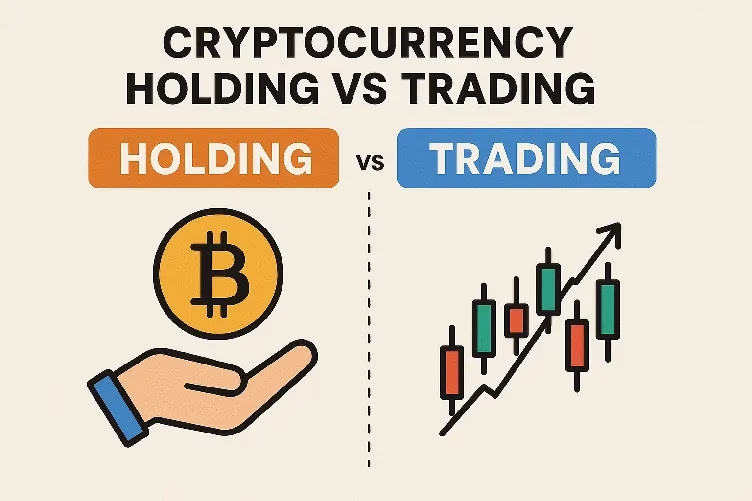
In the ever-changing world of cryptocurrency, one debate refuses to die down — holding vs trading. Every investor, from a curious beginner to a seasoned whale, faces this timeless question: Should I hold my crypto long-term or trade it for short-term profits?
In 2026, the crypto market looks far more mature, liquid, and institutionally connected than ever before. With Bitcoin ETFs thriving, decentralized finance (DeFi) reaching new heights, and AI-driven analytics simplifying strategy, investors are no longer forced to pick sides. A new mindset has emerged — the hybrid strategy, a practical balance between long-term holding and short-term trading.
Let’s break this down step by step — what holding really means, what trading actually involves, and why hybrid strategies have become the smart investor’s favorite approach in 2026.
Understanding the Core Concept of Holding vs Trading
What is Holding (HODL)?
“HODL” started as a misspelling of “hold” on a Bitcoin forum back in 2013. But what began as a joke has become a philosophy. Holding means buying a cryptocurrency and keeping it for the long term — sometimes years — regardless of short-term price fluctuations.
Holders believe in the long-term growth of blockchain technology and see daily volatility as mere noise. They focus on fundamentals like network adoption, developer activity, and protocol utility. When markets crash, holders stay calm, often repeating the classic mantra — “Time in the market beats timing the market.”
Holding fits those who have conviction and patience. It’s not glamorous, but historically, it’s been profitable for disciplined investors who held Bitcoin or Ethereum through multiple bear markets.
What is Trading?
Trading, on the other hand, is the art of capitalizing on price movements. Traders don’t marry their coins — they date them. They analyze charts, read signals, and execute quick buy and sell decisions to profit from volatility.
Unlike holders, traders care less about long-term adoption and more about market momentum. Their goal is to catch trends, ride them for profit, and exit before the tide turns.
Trading can be done in different styles depending on how fast you want to play the game.
The Four Main Styles of Trading
1. Swing Trading
Swing traders operate on a medium timeframe — days or weeks. They rely on technical indicators like moving averages, RSI, and volume analysis to find potential reversals or continuations.
Swing trading blends patience with action. You’re not glued to the screen, but you still need a good sense of timing. It’s ideal for investors who understand holding vs trading dynamics and want to benefit from both momentum and trend strength.
2. Day Trading
Day traders close all positions before the day ends. They live for short-term volatility and small percentage gains that add up over time. It’s fast, stressful, and demands constant focus.
In 2026, AI-based trading bots and lightning-fast exchanges make day trading smoother but still risky. Without strict discipline, emotional reactions can quickly turn profits into losses.
3. Scalping
Scalping is the most intense version of trading. Scalpers aim to make tiny profits — often less than 1% — on quick trades, sometimes lasting just minutes.
This method thrives on high liquidity and tight spreads, which is why 2026’s market structure, with improved decentralized exchanges (DEXs) and Layer-2 speed, has made scalping more popular.
4. Position Trading
Somewhere between swing and holding, position traders maintain positions for weeks or months, following macro trends rather than intraday moves. It’s less stressful and suits those who track news, ETF flows, and institutional activity.
Position trading is often the middle ground in the holding vs trading debate. It’s active enough to catch market cycles but stable enough to avoid daily chaos.
The Rise of Hybrid Strategies in 2026
What is a Hybrid Strategy?
A hybrid strategy combines the patience of holding with the agility of trading. It’s the “best of both worlds” approach — keeping a long-term portfolio for potential 10x growth while using a smaller portion of funds for active trading to take advantage of short-term opportunities.
For example, an investor might hold 70% of their crypto in long-term assets like Bitcoin, Ethereum, or Chainlink while using the remaining 30% for swing trading Solana or Arbitrum when the market is hot.
This model gives you exposure to both long-term appreciation and short-term cash flow. It’s about balance, not bias.
Why Hybrid Strategies Dominate the 2026 Market
In 2026, crypto isn’t a Wild West anymore — it’s a structured ecosystem with institutional liquidity, real-world tokenization, and regulatory clarity in major economies. These advancements have made the holding vs trading debate more sophisticated than ever.
Let’s explore why hybrid strategies have become the dominant choice.
Liquidity Has Changed the Game
Back in 2017, trading crypto was like surfing on stormy water — unpredictable and illiquid. In 2026, liquidity is deeper thanks to the rise of centralized exchange ETFs, regulated brokerages, and high-volume decentralized exchanges.
This liquidity means tighter spreads, faster execution, and fewer manipulative wicks. Traders can enter and exit without huge slippage, while holders can stake or lend assets for passive yield.
As liquidity grows, the line between holding vs trading blurs even more — investors can easily shift between both approaches.
The ETF and Institutional Flow Effect
The arrival of Bitcoin and Ethereum ETFs in major markets changed everything. Institutional investors — hedge funds, pension firms, and corporations — now treat crypto as a legitimate asset class.
These large players add stability to price structures and bring predictable capital inflows. With ETFs holding billions in assets, long-term holders feel more confident. At the same time, traders get clearer signals from institutional order flow and sentiment data.
In short, institutional participation has turned crypto from a speculative playground into a semi-mature financial market, supporting both holding and trading strategies simultaneously.
Mature Infrastructure Encourages Strategy Diversity
Five years ago, crypto tools were basic — clunky charts, slow blockchains, and unreliable APIs. By 2026, everything’s different.
High-speed Layer-2 networks process thousands of transactions per second. On-chain analytics platforms like Nansen and Glassnode deliver real-time insights. Trading bots execute split-second orders without lag.
This evolution has allowed investors to operate efficiently on both sides of the holding vs trading equation. A holder can stake tokens securely while a trader uses bots to exploit short-term volatility — all within one connected ecosystem.
The market’s maturity empowers flexibility. You’re no longer stuck being a “holder” or a “trader.” You can be both — seamlessly.
Emotional Balance and Risk Control
A major reason hybrid strategies shine in 2026 is psychological stability. Full-time trading is stressful. Full-time holding can feel helpless during long bear markets.
A hybrid approach keeps emotions balanced. Long-term holdings provide security, while active trades offer excitement and engagement. It’s easier to stay disciplined when you’re earning on both timelines — steady growth from holdings and active profits from trades.
By managing both sides, investors stay grounded and avoid the panic that often destroys portfolios.
Data, Bots, and AI Assistants
AI-powered trading assistants have become the silent partners of smart investors. These tools can track price momentum, detect whale wallets, and even predict short-term volatility patterns.
With automation handling repetitive analysis, investors can focus more on holding vs trading decisions based on broader strategy rather than emotional impulses. AI reduces the guesswork and enhances timing — something that was nearly impossible a few years ago.
Staking, Yield, and Passive Income Integration
Staking and DeFi yields have turned holding into an income-generating activity. Instead of just letting assets sit, investors can now earn 4–10% APY through decentralized staking platforms.
This means your “holding” side isn’t idle anymore — it’s productive capital. Traders use these yields to offset risks or fund active positions.
Hybrid investors in 2026 enjoy the unique advantage of earning passive income while actively compounding returns through trading.
The New Reality of Holding vs Trading in 2026
The old argument — “Are you a holder or a trader?” — no longer matters. The real question now is “How do you combine both?”
In 2026, successful investors don’t limit themselves. They hold strong assets for the long run while trading dynamic ones for short-term profit. The combination creates resilience, diversification, and steady growth.
The hybrid mindset reflects the maturity of the entire crypto ecosystem. It’s not about extremes anymore — it’s about adaptability. The markets may move fast, but those who balance holding vs trading with clarity and discipline are the ones shaping the new era of crypto investing.
Investor Mindset & Goals
In the world of cryptocurrency, success isn’t just about buying low and selling high — it’s about having the right mindset. Every investor approaches the market differently, and that’s what makes the holding vs trading debate so fascinating. Your decisions are shaped by your personality, patience, and goals.
Some people thrive on the thrill of quick trades, while others prefer to quietly build wealth over time. Both paths can work, but only if you know who you are as an investor. In 2026’s maturing crypto environment, your mindset is your greatest weapon — or your biggest weakness.
Let’s explore how time horizons, risk tolerance, and emotional discipline define your crypto strategy.
Understanding Time-Horizon Mapping
The Importance of Time in Crypto Investing
In traditional finance, investors think in terms of years or decades. In crypto, a month can feel like a year. Prices can double or drop by 50% in days. That’s why understanding your time horizon is crucial before deciding between holding vs trading.
Your timeline dictates your strategy. It determines how much risk you can take and how often you should react to market changes. The clearer your time horizon, the easier it becomes to stay consistent when the market tests your patience.
Short-Term: Days to Weeks
Short-term investors are the adrenaline seekers of the crypto world. They live for volatility, breaking news, and chart patterns. Their focus is on momentum — entering quickly and exiting before the trend fades.
This style fits traders who are comfortable with constant monitoring. They use tools like moving averages, RSI, and candlestick patterns to spot quick opportunities.
In this phase, discipline is everything. Without strict rules, emotions can ruin good setups. When it comes to holding vs trading, short-term players are clearly on the trading side — chasing fast profits while avoiding long-term stagnation.
However, the short-term game is risky. Market manipulation, sudden exchange downtime, or one unexpected tweet can reverse trends instantly. That’s why short-term investors need to combine agility with solid risk management.
Medium-Term: Weeks to Months
Medium-term investors — often called swing traders — balance patience with action. They hold positions long enough to capture meaningful moves but not so long that they face long bear cycles.
This timeframe suits investors who believe in specific catalysts — like a new mainnet launch, ETF approvals, or token upgrades — but don’t want to hold through full market cycles.
Swing traders often use both technical and fundamental analysis. They track on-chain data, sentiment indicators, and key resistance levels. In the holding vs trading spectrum, they stand somewhere in the middle — practical, flexible, and opportunistic.
In 2026, this approach has become popular due to advanced charting tools and real-time analytics. Swing traders can manage portfolios more efficiently than ever before, reducing guesswork and emotion-driven decisions.
Long-Term: Months to Years
Long-term investors — the classic “HODLers” — focus on vision, not volatility. They believe in the fundamental evolution of blockchain and its ability to reshape the global economy.
Their strategy is simple: buy strong assets, secure them safely, and wait. For them, every market dip is a buying opportunity, not a reason to panic.
The long-term mindset demands patience, conviction, and the ability to ignore noise. In the holding vs trading debate, long-term holders represent stability. They understand that real wealth is built over time, not overnight.
But long-term holding isn’t about doing nothing. Smart holders in 2026 use staking, yield farming, and DeFi lending to earn passive returns while waiting for appreciation. They don’t just hold — they make their assets work for them.
Balancing Risk Tolerance and Capital Allocation
Knowing Your Risk Personality
Every investor has a unique risk profile. Some can handle extreme volatility without losing sleep, while others panic at a 10% dip. Understanding your emotional and financial capacity for risk is essential before deciding your place in the holding vs trading spectrum.
Ask yourself — how much can you afford to lose without impacting your lifestyle? If you can’t stomach sharp drawdowns, a holding-heavy approach may be better. If you enjoy analyzing charts and reacting quickly, active trading might suit you more.
Crypto markets in 2026 are still volatile, even with institutional participation. Prices move fast, and emotions move faster. Matching your temperament with your strategy keeps you grounded and consistent.
The Role of Capital Allocation
Once you understand your risk tolerance, the next step is capital allocation — deciding how to divide your money between long-term holds and active trades.
A balanced hybrid investor might allocate 70% to long-term holds (like Bitcoin, Ethereum, or Chainlink) and 30% to trading or high-risk opportunities. This mix provides both stability and excitement.
Aggressive traders might flip that ratio — 30% for holds, 70% for active trading. Conservative investors might do the opposite.
In 2026, diversification goes beyond just coins. Smart investors spread risk across sectors — DeFi, AI tokens, infrastructure plays, and stablecoins. They also keep some liquidity in stable assets to buy dips or hedge during market corrections.
Capital allocation isn’t fixed forever. It evolves with the market and your personal growth as an investor. Adjusting the balance between holding vs trading is a natural part of staying relevant in a fast-changing ecosystem.
Protecting Capital Is Priority One
Many newcomers focus on making profits but forget the first rule of investing — don’t lose money. Protecting your capital is more important than chasing gains.
This means setting stop losses for trades, using hardware wallets for long-term holdings, and avoiding overexposure to a single token.
In 2026, with leveraged instruments and perpetual futures easily accessible, overconfidence is a silent killer. Responsible allocation keeps you in the game long enough to benefit from compounding returns.
Setting Realistic Return Expectations
The Myth of Overnight Riches
Crypto made headlines for creating millionaires overnight. But that narrative is fading. In 2026, smart investors understand that consistent returns beat lucky windfalls.
While it’s true that altcoins can still surge 10x, such gains are rare and unpredictable. Long-term holders aim for steady appreciation, while traders seek smaller, repeatable profits.
In holding vs trading, expectations shape behavior. Unrealistic goals lead to frustration and bad decisions. When you aim for sustainable gains, patience and risk control naturally follow.
The Power of Compounding
One of the most overlooked truths in crypto investing is the power of compounding. Small, consistent gains can outperform occasional big wins.
Hybrid investors, who combine holding with periodic trading, benefit most from compounding. Their long-term holdings grow in value, while short-term trades add incremental profit that can be reinvested.
This steady growth model aligns perfectly with realistic expectations. It’s less stressful and more reliable, especially in a market as volatile as crypto.
Recognizing Psychological Traps
The FOMO Effect
Fear of Missing Out — or FOMO — is the silent destroyer of portfolios. It’s what makes investors buy at the top and panic sell at the bottom.
In the battle of holding vs trading, FOMO affects both camps. Holders may abandon their strategy chasing the latest meme coin. Traders may over-leverage after missing a breakout.
The cure is perspective. The market will always offer new opportunities. Missing one trade doesn’t end your journey. Patience and discipline matter far more than constant action.
Loss Aversion and Emotional Anchors
Humans feel the pain of losing twice as strongly as the joy of winning. This is known as loss aversion. It’s why many investors hold losing positions too long or exit winning ones too early.
In crypto, this emotional bias can be deadly. Traders often refuse to cut losses, hoping for a rebound. Holders sometimes panic during bear markets and sell at the worst time.
The only defense is preparation. Define your entry, target, and exit plan before every position. Treat your portfolio like a business — not an emotional attachment.
The Discipline to Stay Consistent
Mindset, more than skill, decides who survives in crypto. Whether you’re holding or trading, consistency is key. Jumping between strategies in panic mode usually leads to losses.
Those who succeed in 2026 aren’t necessarily the smartest or fastest — they’re the ones who stay consistent, learn from mistakes, and refine their system.
A calm, structured mindset turns holding vs trading from a debate into a personalized plan. In the end, success isn’t about predicting the next big coin. It’s about knowing yourself — your goals, your limits, and your patience — and aligning them with a strategy that truly fits you.
Market Structure Fundamentals
To truly understand holding vs trading in cryptocurrency, you must first grasp how the market actually works beneath the surface. Price charts and headlines tell part of the story, but the real action happens inside market structure — the invisible engine driving every trade, from tiny retail orders to billion-dollar institutional positions.
Crypto markets in 2026 have matured, but they still run on fundamental principles: order books, liquidity, slippage, and spreads. Add in the growing role of derivatives and the importance of secure custody, and you get the full ecosystem that shapes every buy and sell decision.
Let’s explore these pillars one by one — simple, human, and practical.
Order Book Mechanics: Where Every Trade Begins
Understanding the Order Book
At the heart of every exchange — centralized or decentralized — lies the order book. It’s the digital marketplace where buyers and sellers meet. On one side, you have bids (buyers waiting with their prices), and on the other, asks (sellers ready to sell).
When a buyer’s price matches a seller’s ask, a trade happens, and the transaction sets the latest market price. This constant interaction is what creates the visible price movement we see on charts.
The balance between buy and sell orders reflects market sentiment. More aggressive buying pushes prices up, while overwhelming sell pressure drags them down.
For anyone debating holding vs trading, understanding order book behavior helps identify entry and exit points. Holders might use it to time a long-term buy zone, while traders study it to detect short-term momentum or whale activity.
Market Orders vs Limit Orders
When you place a market order, you’re saying, “Buy or sell immediately at the best available price.” It guarantees execution but not the exact price you want. This can lead to slippage — especially during high volatility.
Limit orders, on the other hand, set a specific price. You might place a buy order at $58,000 for Bitcoin, and it will only execute when the market reaches that level. It offers control but no guarantee of execution.
In holding vs trading, long-term investors often use limit orders for gradual accumulation, while active traders switch between both order types to balance speed and precision.
Liquidity: The Lifeblood of the Market
What Liquidity Really Means
Liquidity is how easily you can buy or sell an asset without dramatically affecting its price. A highly liquid market allows large orders to move smoothly. A low-liquidity one turns small orders into chaos.
For example, Bitcoin and Ethereum are extremely liquid. You can sell millions worth without much impact. But a small-cap altcoin might drop 10% from a single large trade.
Liquidity matters for both holders and traders. Holders prefer liquid assets because they can exit during crises. Traders need liquidity to enter and exit positions quickly without paying a hidden “volatility tax.”
Liquidity and Market Depth
Market depth refers to the amount of buy and sell orders at different price levels. A deep market has a dense layer of bids and asks, making it stable and less prone to sudden spikes.
In 2026, liquidity has improved massively due to institutional participation and advanced exchange technology. Centralized exchanges now share liquidity pools with decentralized platforms, creating a more connected trading environment.
Understanding liquidity helps bridge holding vs trading decisions. A well-informed investor knows when to hold through low-liquidity periods and when to avoid thinly traded tokens where price manipulation is easy.
Slippage and Spreads: The Hidden Costs of Trading
What Is Slippage?
Slippage happens when the final price of your trade differs from the price you expected. It’s common during high volatility or in markets with poor liquidity.
Imagine placing a market buy order for a coin at $2.00, but by the time your order executes, it fills at $2.05. That $0.05 difference per token is your slippage — and over time, it eats into profits.
Traders face slippage constantly, while holders experience it less often since they make fewer transactions. Managing slippage is part of mastering holding vs trading — the goal is to reduce unnecessary losses in execution.
The Role of Spreads
The spread is the difference between the highest bid and the lowest ask. It represents the cost of liquidity — how much traders must pay to get immediate execution.
A tight spread means an active market with plenty of buyers and sellers. A wide spread means illiquidity and risk.
In 2026, major exchanges have narrowed spreads significantly thanks to algorithmic market-making and cross-exchange liquidity sharing. This benefits traders who depend on quick entries, but holders also gain from fairer, more transparent prices when building long-term positions.
Spot vs Derivatives: Two Sides of the Same Market
Understanding Spot Trading
Spot trading is the simplest form of crypto investing. You buy or sell an asset for immediate delivery — what you pay is what you get. When you buy Bitcoin on the spot market, it becomes yours instantly, ready to hold, stake, or transfer.
Spot markets are the foundation of holding vs trading strategies. Holders use spot trading to build long-term portfolios. Traders use it to execute short-term entries before switching to derivatives for leverage or hedging.
Spot trades are straightforward and carry no liquidation risk — making them perfect for long-term investors who want direct ownership of assets.
The Rise of Derivatives
Derivatives are financial contracts based on the price of an underlying asset — like futures and options. They don’t give ownership of the asset itself but allow traders to speculate on its price direction.
In 2026, derivatives dominate trading volumes. Institutions use them for hedging, while retail traders use them for leverage. Futures allow you to bet on whether Bitcoin will rise or fall, while options let you manage risk by setting potential price boundaries.
This complexity makes derivatives both powerful and dangerous. When used wisely, they enhance profit potential and risk control. When abused, they lead to quick liquidation.
In holding vs trading, derivatives act as the bridge — giving holders the ability to hedge their portfolios and traders the chance to amplify returns.
Hedging: Protecting Your Holdings
Hedging is like insurance for your portfolio. If you hold Bitcoin long-term but fear a short-term correction, you can open a short futures position. If the price drops, your futures profit offsets your spot loss.
This technique allows holders to stay invested while managing downside risk — a smart way to combine long-term conviction with short-term caution.
For traders, hedging is part of survival. It prevents emotional decisions during market swings and stabilizes overall equity.
Understanding hedging transforms holding vs trading from two separate camps into a unified, risk-balanced strategy.
The Importance of Custody
Why Custody Matters
Owning crypto isn’t like holding stocks. Here, you are the custodian — unless you trust someone else to keep your keys safe. Custody defines how securely you own and store your assets, which affects both holders and traders.
“Not your keys, not your coins” is still the golden rule. But in 2026, custody options are far more diverse — from institutional-grade vaults to decentralized multi-signature wallets.
The better your custody setup, the safer your investments, regardless of your approach in holding vs trading.
On-Chain vs Off-Chain Custody
On-chain custody means you hold crypto directly in a blockchain wallet — under your own control. Hardware wallets like Ledger or Trezor store private keys offline, offering maximum security. This is ideal for long-term holders who don’t need daily access.
Off-chain custody, meanwhile, involves keeping funds on exchanges or with custodial services. It offers convenience for active traders who need liquidity and fast order execution.
Each has pros and cons. On-chain custody gives full control but requires responsibility — lose your keys, lose your coins. Off-chain custody is flexible but carries counterparty risk if a platform fails or gets hacked.
Smart investors blend both. They hold long-term assets on-chain for safety while keeping a small trading balance off-chain for active use. That balance perfectly mirrors the holding vs trading hybrid mindset.
Custody Innovations in 2026
The landscape has evolved. Institutional-grade custodians now use multi-party computation (MPC) technology, allowing secure key management without exposing private keys. DeFi platforms integrate wallet recovery systems, reducing loss risks.
Meanwhile, decentralized exchanges let you trade directly from your wallet without giving up custody — closing the gap between security and convenience.
For both holders and traders, these innovations represent freedom and confidence. You no longer have to choose between control and usability — you can have both.
The Custody-Strategy Connection
Your storage decision directly affects your strategy. Holders prioritize cold storage for security, while traders prioritize exchange wallets for accessibility.
The best hybrid investors adapt. They know when to keep funds offline and when to bring them online for opportunities. They treat custody not as an afterthought but as a core part of holding vs trading.
In 2026, understanding market structure isn’t just technical knowledge — it’s financial self-defense. Whether you’re holding for the long run or trading for quick gains, knowing how the system operates gives you clarity, confidence, and control over every move you make.
Fundamental Analysis: The Backbone of Smart Crypto Decisions
When the crypto markets heat up, it’s easy to get swept away by shiny charts and hype-filled tweets. But behind every price movement lies a foundation — the fundamentals. Understanding those fundamentals separates serious investors from speculative gamblers. Whether you’re comparing holding vs trading, strong analysis is the compass that keeps you from drifting in emotional tides.
Fundamental analysis in crypto goes beyond reading price action. It’s about studying what gives a token real value: the technology, usage, development, and adoption behind it. Holders rely on this knowledge to identify projects with long-term potential. Traders use it to find momentum before the market catches on.
Let’s explore how on-chain metrics, protocol strength, and ecosystem health form the holy trinity of crypto fundamentals.
On-Chain Metrics: Reading the Blockchain’s Pulse
The Power of Data You Can’t Fake
In traditional finance, analysts rely on company reports that can be tweaked or delayed. But in crypto, every transaction lives on the blockchain — transparent, verifiable, and open for anyone to analyze. On-chain data tells the truth about network activity, user behavior, and real adoption.
For anyone evaluating holding vs trading, these metrics provide clarity. Holders use them to spot growing networks worth keeping for years. Traders use them to detect short-term surges in activity that often precede price rallies.
Active Addresses and Network Usage
One of the simplest yet most powerful indicators is the number of active addresses. It shows how many unique users are actually sending or receiving tokens on the network.
A consistent rise in active addresses often signals growing adoption — a positive sign for holders. Think of it as more people joining a digital economy. For traders, sudden spikes in active addresses can suggest increased speculation or upcoming news-driven volatility.
In holding vs trading, active addresses serve both worlds: long-term conviction for holders, real-time market hints for traders.
Transaction Fees and Network Congestion
Transaction fees reveal demand for block space. When a network becomes busy, users compete by paying higher fees.
For instance, high Ethereum gas fees often mean booming activity in DeFi or NFTs. Bitcoin’s fee surges indicate rising usage and miner demand. But consistently low fees can also be positive — signaling scalability improvements or efficient protocol design.
Holders interpret rising fees as proof of utility, while traders view them as volatility indicators. Understanding this dual meaning helps balance holding vs trading strategies with context, not guesswork.
Total Value Locked (TVL)
TVL measures how much crypto is locked in a network’s smart contracts — mostly in DeFi protocols. It reflects both user trust and real capital commitment.
A growing TVL signals healthy ecosystem participation. For example, Ethereum, Solana, and Arbitrum have seen TVL growth spur price appreciation in previous cycles.
Holders see rising TVL as long-term confidence. Traders, on the other hand, monitor TVL flows between chains to find short-term rotation trends. In 2026, cross-chain TVL tracking tools have become essential to anyone mastering holding vs trading.
Staking Participation and Tokenomics
In proof-of-stake networks, staking shows how much of the supply is locked to secure the network. High staking ratios can reduce circulating supply and stabilize prices. But extremely high ratios might lower liquidity — something traders dislike.
Tokenomics — the study of how a token’s supply, distribution, and incentives work — is the blueprint of sustainability. Inflationary tokens may reward early holders but hurt long-term value. Deflationary or capped-supply models often attract long-term believers.
For holding vs trading, tokenomics decide the rhythm: holders seek sustainable, well-balanced models, while traders exploit temporary inefficiencies caused by unlocks or emission events.
Protocol Fundamentals: What Makes a Project Worth Believing In
Total Value Secured and Network Strength
Beyond TVL, total value secured measures how much capital or data a blockchain safeguards. For example, Ethereum secures billions through DeFi, NFTs, and tokenized assets. Bitcoin secures the world’s largest store of decentralized value.
The more value a protocol secures, the more trusted it becomes. For holders, this reflects durability. For traders, it reflects confidence — markets reward networks that anchor trust.
When comparing holding vs trading, think of total value secured as the safety net for conviction. It reminds investors that real adoption isn’t about speculation — it’s about what people entrust the network with.
Upgrade Roadmap and Innovation Cycle
Crypto projects live or die by innovation. A clear, transparent roadmap builds confidence that the team isn’t just surviving — they’re evolving.
Ethereum’s move from proof-of-work to proof-of-stake and ongoing scaling upgrades set an industry standard. Solana’s performance enhancements and Avalanche’s subnets show continuous evolution.
For holders, strong development roadmaps represent longevity. For traders, roadmap milestones create volatility events. Network upgrades, token burns, or mainnet launches often trigger price spikes — opportunities for short-term gains.
In holding vs trading, roadmaps act as both compass and calendar. They help holders plan for the future and traders prepare for market reactions.
Developer Activity and Open-Source Commitment
The health of a blockchain depends on its builders. Developer activity — tracked through GitHub commits, pull requests, and open-source updates — reflects the pulse of innovation.
A project with an active developer community adapts, scales, and stays competitive. Dormant repos often foreshadow decline.
Holders look for steady, long-term development that ensures the project won’t vanish. Traders look for sudden bursts of developer engagement, which often attract short-term speculative attention.
In 2026, AI-driven data tools now measure not only code volume but also quality and collaboration patterns. It’s a smarter way to assess fundamentals, bridging holding vs trading strategies through verifiable innovation.
Ecosystem Health: Measuring Real-World Impact
Wallet Growth and User Onboarding
Wallets are the first touchpoint between users and the blockchain. Rapid wallet growth shows adoption spreading beyond crypto-native audiences.
Holders love to see organic wallet creation — it means long-term relevance. Traders watch wallet activity to detect momentum inflows or exit trends.
When discussing holding vs trading, wallets act as proof of grassroots strength. The more people use the network directly, the stronger the base becomes for both long-term and short-term moves.
DEX Volumes and Liquidity Rotation
Decentralized exchange (DEX) volumes represent how much trading happens without intermediaries. Rising DEX volumes indicate strong community trust and liquidity distribution.
For holders, this shows that the ecosystem is self-sufficient and healthy. For traders, DEX volume surges often precede centralized exchange listings or news-driven rallies.
In 2026, DEXs like Uniswap, Curve, and Jupiter have become liquidity hubs that mirror broader sentiment. Understanding volume flows across them helps refine the holding vs trading approach — letting you see where capital is moving before the crowd reacts.
Bridges and Interoperability
Bridges connect blockchains, allowing assets to move freely between them. Cross-chain liquidity and communication have become the backbone of the modern crypto landscape.
A project’s bridge activity reflects how integrated it is into the broader ecosystem. For holders, strong bridge adoption signals long-term utility. For traders, bridge congestion or flow spikes often predict capital migration between ecosystems — useful for short-term plays.
In holding vs trading, watching bridge usage reveals both growth potential and early warning signs of systemic stress.
Developer Tooling and Partnerships
Even the best blockchain can fail without developer-friendly tools. SDKs, APIs, and plug-and-play solutions attract builders who create real-world use cases. The more builders, the more apps, and the more demand for the token.
Strategic partnerships — with payment networks, gaming companies, or DeFi protocols — amplify this effect. They expand reach, add legitimacy, and increase utility.
Holders view partnerships as a signal of mainstream acceptance. Traders see them as catalysts that can trigger fast price reactions. Both rely on them to validate project momentum in the ongoing debate of holding vs trading.
Community and Governance Participation
No blockchain thrives without its community. Active governance, voting, and proposal participation indicate engaged users who care about the network’s direction.
Holders benefit from stable, community-driven projects with transparent governance. Traders watch governance votes and proposals as potential market triggers — upgrades, burns, or treasury changes can move prices fast.
In 2026, decentralized governance has matured, merging social and technical signals into one metric of ecosystem health. A vibrant community is both a safety net and a growth engine.
Why Fundamentals Still Matter in 2026
Despite the noise of memes, hype, and short-term volatility, fundamentals remain the cornerstone of success in crypto. Whether you’re a patient holder or an active trader, knowing what lies beneath the surface gives you an unbeatable edge.
In the ever-evolving world of holding vs trading, those who master fundamental analysis don’t just follow trends — they anticipate them. They see beyond price charts into the living, breathing systems that define the future of digital finance.
Technical Analysis & Risk Control: The Trader’s Precision Toolkit
When emotions start flying in crypto markets, logic is the first casualty. That’s where technical analysis steps in — the language of market psychology written in charts. It’s not fortune-telling. It’s pattern recognition, probability, and disciplined execution.
For those balancing holding vs trading, understanding technical analysis (TA) is like learning to read the ocean before setting sail. Holders may glance at long-term trends to confirm conviction, but traders live and breathe these signals daily. Yet no amount of chart mastery matters without one critical factor — risk control.
Let’s dive into the tools, tactics, and psychological habits that define successful technical traders in 2026.
The Building Blocks of Technical Analysis
The Foundation: Price and Time
At its heart, TA studies how price moves over time. Every candle, wick, and pattern represents the collective emotion of millions of participants — fear, greed, and hesitation.
Holders focus on big-picture structure: higher highs, macro breakouts, and multi-month moving averages. Traders zoom in — watching intraday momentum, liquidity pockets, and breakout confirmations.
In the holding vs trading framework, TA bridges long-term belief and short-term execution. It helps holders optimize entries and traders sharpen exits.
Key Tools of Technical Analysis
Trendlines: The Simplest Truth on a Chart
A trendline connects two or more key price points, showing the market’s direction — up, down, or sideways. Simple, yes, but powerful.
Uptrend lines reveal demand zones where buyers consistently step in. Downtrend lines mark supply zones where sellers dominate. When these lines break, market structure often shifts.
For holders, trendlines confirm accumulation zones for long-term buys. For traders, they signal potential reversals or breakout plays. In both holding vs trading, trendlines are the visual heartbeat of sentiment.
Moving Averages: The Market’s Memory
Moving averages (MA) smooth out noisy data, revealing the underlying direction. The 50-day and 200-day MAs are classic benchmarks. When the short-term MA crosses above the long-term one — the famous “golden cross” — it often signals strength. The opposite, the “death cross,” warns of weakness.
Traders use exponential moving averages (EMA) for faster reactions. Holders prefer simple moving averages (SMA) to identify long-term trend health.
In holding vs trading, MAs create structure: holders rely on them to validate trend sustainability, while traders ride the waves between crossovers.
RSI: The Emotion Barometer
The Relative Strength Index (RSI) measures momentum — whether an asset is overbought or oversold. Values above 70 suggest overbought conditions, while below 30 implies oversold.
Holders interpret RSI extremes as potential accumulation or distribution phases. Traders use it dynamically, buying dips during uptrends and shorting spikes during downtrends.
In the world of holding vs trading, RSI bridges psychology with timing. It reminds investors that markets aren’t just numbers — they’re human emotion on display.
Volume Profile and VWAP: The Invisible Map of Demand
Volume is truth. Prices can lie, but volume tells where real interest lies.
Volume Profile shows the most traded price levels — the zones where buyers and sellers agree on value. These become strong support or resistance areas. VWAP (Volume Weighted Average Price) acts like a magnetic line, showing the average price weighted by volume throughout the day.
Traders use VWAP as a benchmark for fair value. If price trades above VWAP, it signals bullish control; below, it implies bearish sentiment.
Holders use volume analysis to spot long-term accumulation zones, while traders depend on it to plan precise entries and exits. In holding vs trading, volume is the ultimate confirmation tool — it validates conviction with participation.
Fibonacci Levels: The Geometry of Market Psychology
Fibonacci retracements are not magic — they’re patterns based on human behavior. The 38.2%, 50%, and 61.8% levels often act as reaction points where trends pause or reverse.
Traders use them to identify support and resistance. Holders watch them to accumulate during healthy corrections in long-term uptrends.
When it comes to holding vs trading, Fibonacci helps structure both patience and precision — letting traders act strategically instead of emotionally.
Market Regimes: Knowing What Environment You’re In
Range-Bound Markets: The Trap of Noise
Sometimes, the market goes nowhere. Prices oscillate between clear boundaries — boring for holders, frustrating for traders.
In range markets, holders usually stay inactive, letting time smooth volatility. Traders switch tactics — buying support, selling resistance, and avoiding breakout traps.
For holding vs trading, recognizing a range keeps both sides disciplined. Holders don’t panic during sideways motion, and traders don’t waste capital chasing fake moves.
Trending Markets: Riding the Wave
When prices establish direction — up or down — trends become traders’ playgrounds.
Holders enjoy trending bull markets by simply staying invested. Traders exploit trends by entering on pullbacks and pyramiding positions carefully.
The key lies in confirmation. Use moving averages, higher highs/lows, and volume spikes to validate trend strength.
In holding vs trading, trending markets unite both camps — holders grow wealth through patience, traders through precision.
High-Volatility Markets: The Emotional Battlefield
Crypto’s DNA is volatility. Huge candles, flash crashes, and news-driven whiplash define its nature.
For holders, volatility is background noise — unless they’re overexposed. For traders, it’s opportunity and danger in equal measure. Tight stops, reduced position sizes, and adaptive strategies are essential.
In these conditions, mastering holding vs trading means emotional control. React less, plan more, and never chase impulsively.
Risk Control: The Shield of Every Strategy
The Rule of Survival
The first rule of trading isn’t making money — it’s not losing it. Risk control ensures that even after a series of bad trades, you’re still in the game.
Holders manage risk by diversification, steady accumulation, and avoiding emotional sells. Traders do it with stop losses, position sizing, and capital preservation.
No matter how skilled, everyone faces drawdowns. The difference between winners and losers lies in how they manage them. That’s where holding vs trading philosophies meet — both depend on discipline.
Position Sizing: The Art of Balance
Position sizing decides how much of your portfolio goes into each trade. Too big, and one loss hurts. Too small, and profits barely matter.
Fixed Fractional Method
Here, you risk a fixed percentage of your capital per trade — say, 2%. This keeps losses controlled, no matter how volatile the asset gets.
Kelly-Lite Formula
The Kelly Criterion helps maximize growth without overexposure. The “lite” version tones it down for practicality, balancing risk and reward.
In holding vs trading, position sizing is the unsung hero. Holders use it for portfolio allocation; traders use it for precision entries. Both rely on it to protect longevity.
Stop Losses vs Mental Stops
A stop loss is a pre-set exit that limits downside risk automatically. It enforces discipline — even when emotions scream otherwise.
But not all traders use hard stops. Some prefer mental stops — pre-decided levels where they exit manually. This works only for highly disciplined individuals who can act without hesitation.
For holders, stop losses are rarely used. Instead, they define invalidation zones — points where the long-term thesis breaks.
In holding vs trading, stop management defines character. Traders cut losses fast; holders endure temporary pain for future gain. Both require clarity and conviction.
Blending Technicals with Risk Awareness
When to Step Back
No matter how skilled, traders need rest. Overtrading kills performance. Similarly, holders need to reassess periodically — conviction without review becomes stubbornness.
In volatile cycles, combining TA with risk control offers perspective. Technical indicators show what’s happening; risk management defines how you respond.
The Power of Probabilities
TA doesn’t predict the future — it narrows possibilities. Smart traders think in probabilities, not certainties. Every setup is a bet with calculated odds, backed by protective measures.
In holding vs trading, probabilities guide patience. Holders wait for conviction setups; traders execute only when the odds align.
Adapting in 2026: From Indicators to Intelligence
By 2026, technical analysis has evolved. AI-assisted platforms now integrate real-time sentiment, liquidity heatmaps, and predictive volatility modeling. But the core principles remain timeless: trends, volume, and discipline.
Technology amplifies insight — not wisdom. The trader’s edge still lies in emotional control, not software complexity.
Whether you’re holding through storms or trading the tides, charts are not just lines — they’re lessons. And mastering them turns holding vs trading from a competition into a complete strategy, built on logic, patience, and controlled risk.
Building a Hybrid Strategy: The Smart Investor’s Blueprint
By 2026, the line between holding vs trading has blurred. Pure holders no longer sit idle through bear markets, and full-time traders have learned that not every minute on the charts leads to profit. The modern investor blends both — building a hybrid strategy that combines long-term conviction with short-term opportunity.
A hybrid approach isn’t about doing everything at once. It’s about balance — managing risk while staying adaptable. Let’s walk through the process step-by-step, from seed allocation to hedging, using a structure that’s practical, flexible, and designed for real-world crypto investors.
Seed Allocation: Structuring Your Capital with Purpose
Why Allocation Is the Foundation
Before you buy your first token or open your first trade, decide how much of your total capital belongs in each category. Without this structure, emotion rules your portfolio.
A hybrid investor doesn’t just think about what to buy — they plan how much to buy and why. The goal is to create layers of risk: a stable base, a dynamic middle, and a speculative edge. This layered approach defines the essence of holding vs trading in 2026.
The 60/30/10 Model
A common hybrid framework looks like this:
- 60% Core Holds: Your long-term, conviction-based assets — typically Bitcoin, Ethereum, and other blue-chip tokens. You hold these through cycles, rarely selling.
- 30% Swing Trades: Mid-term positions based on technical or narrative trends. You enter and exit over weeks or months.
- 10% High-Risk Punts: Small, speculative bets on new projects, launchpads, or low-cap gems. These could 10x — or vanish.
This structure brings balance to holding vs trading. The core gives you stability and compound growth, while swing and speculative portions feed your active side.
Variants for Different Risk Profiles
Not everyone fits one mold. If you’re conservative, go 80/15/5 — prioritize safety. If you’re aggressive and enjoy active management, try 50/40/10 or even 40/50/10.
The key is honesty. Know your risk tolerance and time commitment. If you can’t check charts daily, stay heavier on long-term holds. If you love market analysis, shift slightly toward trading.
Hybrid investing isn’t rigid — it evolves with your experience and confidence.
Laddering into Positions: Patience as a Strategy
The Myth of the Perfect Entry
No one — not even professionals — catches exact tops or bottoms. That’s why smart investors use laddering. It’s a calm, structured way to enter or exit positions over time.
In holding vs trading, laddering protects holders from overpaying and traders from overreacting. It’s risk control disguised as patience.
Dollar-Cost Averaging (DCA)
DCA means investing a fixed amount at regular intervals, regardless of price. If Bitcoin trades at $60,000 this month and $55,000 next month, you buy both times. Over time, your average entry smooths out volatility.
Holders use DCA to build core positions without emotional timing. Traders use it to scale into setups where confirmation takes time.
In a hybrid setup, DCA fits perfectly into the 60% long-term layer — steady, consistent, and emotion-free accumulation.
Pyramiding for Traders
While holders use DCA to enter gradually, traders use pyramiding to build winning positions. The idea is simple: you add to trades only when they’re already profitable.
Instead of going all-in at once, you start small and add as the market confirms your bias. This minimizes risk if you’re wrong and maximizes profit when you’re right.
For holding vs trading, DCA and pyramiding represent the same principle — scaling strategically. The difference lies in time horizon and execution speed.
Laddering Out — The Forgotten Skill
Exiting positions gradually is just as powerful as entering them slowly. Selling in parts helps capture profits while leaving room for further upside.
Holders might sell portions at 2x, 3x, and 5x to secure gains. Traders might scale out in thirds to avoid exit anxiety.
In a hybrid strategy, laddering out locks profits from trades and recycles them back into long-term holdings — keeping your portfolio in motion without losing direction.
Rebalancing Rules and Triggers: Keeping the Engine Tuned
Why Rebalancing Matters
Over time, markets shift. A small trade can grow into a major portion of your portfolio, or your high-risk bets might outpace your core holds. Without rebalancing, you lose alignment with your goals.
Rebalancing brings order. It ensures that your risk exposure matches your intended design — the foundation of discipline in holding vs trading.
Time-Based Rebalancing
This method uses a set schedule. For example, rebalance every quarter or twice a year. It’s simple, consistent, and keeps emotion out of the process.
At each checkpoint, you redistribute profits: trim winners, add to laggards, or increase cash. It’s like a portfolio tune-up that keeps your machine efficient.
Holders prefer this method since it aligns with long-term cycles. Traders can use it too, adjusting allocations after major runs or corrections.
Threshold-Based Rebalancing
This method triggers action when allocations drift too far. If your 30% swing-trade portion grows to 45%, you trim it back and move profits into long-term holds or stablecoins.
Threshold-based systems are dynamic — ideal for volatile markets. They react to movement rather than time.
For holding vs trading, this approach bridges flexibility and control. It keeps your portfolio responsive while maintaining structure.
Combining Both Approaches
Many hybrid investors use a mix of both. They perform scheduled reviews but only rebalance if deviations exceed set limits — say, 10%. This avoids over-adjusting while keeping discipline intact.
A hybrid strategy is not about constant tinkering. It’s about intelligent maintenance — letting profits compound while preventing imbalance.
Using Derivatives to Hedge Long-Term Holdings
The Logic of Hedging
Every holder eventually faces the same dilemma: what if the market drops suddenly? Selling isn’t always the answer — it can trigger taxes, miss rebounds, and break your long-term conviction.
That’s where derivatives step in. Used correctly, they let you protect your portfolio without liquidating your holdings. It’s the perfect crossover tool in holding vs trading.
Basic Hedging Tools: Put Options and Short Futures
A put option gives you the right (but not the obligation) to sell an asset at a specific price. If Bitcoin drops below that level, the put gains value, offsetting losses on your spot holdings.
A short futures contract works differently. It’s an agreement to sell an asset at a future date. If the price falls, the short position profits.
Both tools create insurance-like protection for holders who want to stay invested while managing downside risk.
Traders use these same tools to speculate. Holders use them to preserve value. That’s the duality of holding vs trading — same instruments, different intentions.
When to Hedge
Hedging isn’t a full-time strategy — it’s a temporary shield during uncertain conditions. Macro risk, overheated markets, or major regulatory events are typical triggers.
The key is timing. Hedge before panic begins, not after. Like insurance, it’s best bought in calm periods when costs (premiums or funding rates) are low.
Understanding the Risks
Derivatives magnify both profit and loss. A poorly managed hedge can drain capital faster than a market correction itself. Over-leveraging or mis-sizing contracts can turn protection into speculation.
A good rule: hedge no more than 25–30% of your long-term holdings. Enough to soften impact, not enough to cancel upside.
Hybrid investors thrive on balance — using derivatives to protect, not to gamble. That’s how they stay steady when volatility tests conviction.
The Psychology Behind Hybrid Investing
The Calm in Flexibility
A hybrid approach isn’t about switching identities — it’s about staying flexible. When markets rally, your trades amplify gains. When they correct, your holds anchor stability.
It’s a rhythm, not a conflict. The true power of holding vs trading lies in combining patience with adaptability.
Discipline Over Emotion
Hybrid investors follow rules — not moods. They set allocations, plan ladders, and define triggers before taking action.
Emotion is reactive. Strategy is proactive. The difference shows over time, not in a single trade.
Evolution, Not Perfection
Your hybrid structure will evolve. As your experience grows, you’ll tweak allocations, test new rebalancing intervals, or refine hedging tactics. That’s normal.
What matters is consistency. Hybrid investors don’t chase perfection — they build resilience.
In 2026, as crypto matures and institutional money deepens liquidity, hybrid strategies have become the gold standard. The debate of holding vs trading no longer divides investors — it unites them. The most successful portfolios now stand on both pillars: long-term conviction fortified by tactical precision.
Security, Custody & Tax Basics Every Crypto Investor Must Know
Whether you prefer holding vs trading, one truth stands firm — none of it matters if your crypto isn’t secure. You can master charts, tokenomics, and hybrid strategies, but without solid custody and recordkeeping, your portfolio stands on shaky ground. Security isn’t just a technical subject; it’s a mindset, a daily habit that separates successful investors from reckless gamblers.
Let’s explore how to safeguard your digital wealth, protect against human error, and understand the tax implications that come with every move in your crypto journey.
Understanding Self-Custody vs Custodial Exchanges
What Custody Really Means
Custody defines who controls your private keys. In crypto, control equals ownership. If you don’t hold the keys, you don’t truly own the coins. It’s a lesson learned through hard crashes and exchange failures — from Mt. Gox in 2014 to FTX in 2022.
In the debate of holding vs trading, custody shapes how you interact with your assets. Long-term holders prioritize self-custody, while active traders often rely on exchanges for liquidity and execution. Both have benefits and risks.
Self-Custody: Owning Your Keys
Self-custody means you store your crypto yourself, typically using hardware wallets like Ledger, Trezor, or SafePal. Your private keys never leave the device, keeping you safe from exchange hacks or insolvency.
For long-term holders, self-custody aligns perfectly with their philosophy — buy, store, and sleep peacefully knowing that no third party can freeze or misuse funds.
However, it comes with responsibility. Lose your recovery phrase, and your coins vanish forever. There’s no “forgot password” option in blockchain. That’s why discipline and redundancy are crucial.
Custodial Exchanges: Convenience Meets Risk
Custodial exchanges like Binance, Coinbase, or Kraken manage private keys for you. They’re convenient, fast, and essential for active traders who need instant access to markets and advanced tools.
But here’s the trade-off — you give up control. If the exchange suspends withdrawals or suffers a breach, your assets could be locked or lost. It’s the classic balance between freedom and convenience in the world of holding vs trading.
Traders use exchanges for execution but often transfer profits or reserves back to self-custody wallets. That’s how hybrid investors minimize exposure without sacrificing flexibility.
The Hybrid Custody Approach
Smart investors blend both worlds. Keep long-term holdings in hardware wallets and maintain a smaller portion on trusted exchanges for trading or liquidity.
This mix allows flexibility while reducing risk. It’s the same principle that governs a hybrid investment strategy — diversifying not just across assets, but across storage methods.
For example, you might keep 80% of your crypto in cold storage and 20% in exchange wallets for active use. This balance ensures security without limiting opportunity.
Best Practices for Crypto Security
Multisig Wallets: Shared Protection
A multisignature wallet requires multiple private keys to authorize a transaction. Think of it as a digital safe that needs two or more people to unlock it.
Projects, DAOs, and families use multisig wallets to distribute control, reducing single-point failure. Even if one key gets compromised, the funds remain protected.
For serious holders, multisig setups like Gnosis Safe or Electrum Multisig offer institutional-grade security without sacrificing self-custody principles.
Seed Phrase Hygiene: Your Ultimate Backup
Your seed phrase — a list of 12 or 24 words — is the master key to your wallet. If someone gets it, they can empty your funds. If you lose it, no one can recover your assets.
Write it down offline on paper or metal, never store it digitally, and keep multiple copies in separate, secure locations. Avoid taking photos or screenshots. Those small conveniences often become big regrets.
In the context of holding vs trading, holders tend to store seed phrases for long-term protection, while traders must also back up wallets tied to exchanges or browser extensions like MetaMask. Everyone, regardless of strategy, should treat the seed phrase like a sacred document.
Phishing Awareness: Don’t Click, Verify
Phishing remains one of the most common attack vectors in crypto. Scammers impersonate wallet providers, exchanges, or even influencers to trick you into revealing private keys or seed phrases.
Always verify URLs manually and use bookmarked links for exchanges or wallets. Never click links from unsolicited emails or social media messages.
Double-check everything — from sender names to domain endings. Remember, no legitimate platform will ever ask for your private key or seed phrase.
In holding vs trading, traders are often more exposed since they engage frequently online. Holders, though less active, must still stay vigilant against fake wallet updates or software downloads.
Hardware Hygiene and Physical Security
Security doesn’t end at the digital level. Keep your hardware wallet’s firmware updated, and avoid connecting it to public or shared computers.
If possible, use an air-gapped device — one that never connects to the internet — for added safety. Store devices in secure locations like safes, not drawers or desks.
A small investment in hardware hygiene today prevents devastating losses tomorrow. Whether you lean toward holding vs trading, protecting your assets should never be optional.
Tax Implications: What Every Investor Must Know
Holding vs Trading from a Tax Perspective
Governments worldwide are catching up with crypto. Whether you’re holding for years or trading daily, taxation plays a major role in your net profit.
In simple terms:
- Holding leads to capital gains tax when you sell after a long duration, often taxed at lower rates.
- Trading generates short-term gains, taxed at higher, regular income rates since positions are frequently opened and closed.
This difference changes how investors manage portfolios. Hybrid strategies need clear records to separate long-term gains from trading income.
Tracking Tools: Your Tax Lifeline
Manual tracking is impossible when you’re managing multiple wallets and exchanges. Thankfully, there are reliable tools like CoinTracking, Koinly, TokenTax, and ZenLedger that automatically sync transactions, calculate gains, and prepare tax reports.
For hybrid investors balancing holding vs trading, these tools simplify compliance. They consolidate data from all sources — on-chain and off-chain — making sure nothing slips through the cracks.
Set them up early in the year, not right before deadlines. Tax preparation is smoother when done gradually, not in panic mode.
Recordkeeping Best Practices
Even with software help, keep your own records. Maintain a spreadsheet or document containing transaction summaries, exchange statements, and wallet addresses.
Note down every major buy, sell, or transfer, along with reasons — like “long-term hold” or “swing trade.” This helps justify positions if tax authorities ever request details.
Long-term holders benefit from simpler records, but traders face heavier documentation requirements due to higher transaction frequency. This is another reason why clarity in holding vs trading matters — it keeps your tax life organized and stress-free.
The Global Shift Toward Crypto Regulation
2026 is shaping up as a defining year for crypto taxation. Countries like the U.S., India, and Germany are implementing clearer frameworks for digital asset gains.
Ignoring tax rules can lead to penalties, but overreporting can also cost you unnecessarily. Stay updated on local regulations or consult a crypto-aware tax professional.
In a hybrid approach, having part of your portfolio long-term and part for active trading means juggling multiple tax timelines. Awareness and accuracy here protect both profits and peace of mind.
Making Security and Compliance a Habit
Security and taxes might sound dull compared to chart analysis or yield farming, but they’re the backbone of a sustainable crypto career. One hack or audit notice can undo years of smart investing.
Whether your focus leans toward holding vs trading, the principles remain universal:
Own your keys. Protect your phrases. Verify everything. Record every move.
This isn’t paranoia — it’s professionalism. In an industry built on decentralization, responsibility is the new freedom. Those who embrace it thrive; those who ignore it, eventually pay for it.
Crypto rewards discipline, not luck — and mastering security, custody, and tax compliance is how true investors prove it.
Tools, Platforms & Bot Use: Navigating the 2026 Crypto Landscape
In the evolving world of crypto, success now depends as much on your tools as on your timing. The difference between profit and frustration often lies in what platforms you choose, how you track performance, and whether you let automation work for you.
As the holding vs trading debate matures in 2026, investors are realizing that both strategies benefit from technology. Holders use analytics and secure wallets to stay informed and protected, while traders rely on advanced exchanges, bots, and real-time data to act fast. Let’s explore the essential platforms, software, and automation strategies shaping this new age of intelligent investing.
Centralized Exchanges vs Decentralized Exchanges
The Two Pillars of Liquidity
In crypto, liquidity is life. It’s what allows you to buy or sell an asset without moving its price drastically. That’s where centralized exchanges (CEXs) and decentralized exchanges (DEXs) come into play — each serving different needs depending on whether you prefer holding vs trading.
Centralized exchanges like Binance, Coinbase, and Kraken remain dominant in 2026. They offer deep liquidity, advanced order types, and fast execution speeds. DEXs like Uniswap, Curve, and Jupiter (on Solana) have matured too — offering better interfaces, cross-chain swaps, and even institutional-grade liquidity pools.
Centralized Exchanges: Speed, Volume & Reliability
CEXs continue to dominate active trading. Their appeal lies in smooth execution, large trading pairs, and fiat on-ramps. For traders, milliseconds matter — and centralized servers handle that effortlessly.
Platforms like Binance and Bybit now integrate AI-assisted order routing, helping traders minimize slippage and optimize position entries. Risk dashboards show portfolio exposure across futures, options, and spot markets in real-time.
However, there’s a cost — trust. CEXs require you to deposit funds, meaning you surrender self-custody. For holders, that’s often a dealbreaker. But for active traders in the holding vs trading balance, CEXs remain indispensable due to their unmatched liquidity and convenience.
Decentralized Exchanges: Freedom, Transparency & Control
DEXs have come a long way from their clunky early interfaces. In 2026, they’re faster, cheaper, and safer. Protocols like Uniswap v5, PancakeSwap v4, and dYdX chain provide near-CEX execution quality but without centralized custody risks.
Smart routing and aggregator DEXs like 1inch or Jupiter automatically find the best prices across multiple liquidity pools. Fees are transparent, and you keep full control of your assets through self-custody wallets like MetaMask or Rabby.
For holders leaning toward long-term conviction, DEXs offer peace of mind — no third-party custody. For traders, they present endless opportunities to interact directly with markets, though still with occasional slippage during volatile periods.
In the grand scheme of holding vs trading, the hybrid investor uses both. Long-term assets rest safely in DeFi vaults or staking contracts, while trading positions are executed on liquid centralized platforms.
Portfolio Trackers and Management Tools
The Rise of Smart Dashboards
With assets spread across multiple wallets, exchanges, and blockchains, portfolio tracking has become a full-time task. Thankfully, 2026 brings a generation of AI-driven portfolio trackers that consolidate everything into one intuitive dashboard.
Platforms like Zerion, CoinStats, DeBank, and Kubera automatically sync your wallets, DEX positions, NFTs, and even staking rewards. They also calculate unrealized gains, APYs, and asset correlations.
For holders, these tools provide a clear long-term snapshot of wealth and performance. For traders, they show instant liquidity positions and unrealized profits. In holding vs trading, a good tracker is the glue that keeps strategy and execution aligned.
Tax Software Integration
Most portfolio trackers now integrate directly with tax software like Koinly, CoinTracking, and ZenLedger. This is crucial because crypto activity generates hundreds of transactions across networks.
These tools automatically categorize income types — whether staking rewards (passive income) or short-term trades (active gains). They also generate compliant tax reports for local jurisdictions.
For hybrid investors practicing holding vs trading, automation removes the headache of manual recordkeeping. Each transaction syncs seamlessly, turning tax season into a simple export-click routine rather than a month-long nightmare.
On-Chain Analytics: The Data Behind Decisions
Reading the Blockchain Like a Pro
On-chain analytics has become the new technical analysis. Instead of just studying charts, investors now examine blockchain activity — wallet behavior, transaction flow, and protocol health — to forecast trends.
Platforms like Glassnode, Nansen, Santiment, and Messari turn raw blockchain data into actionable insights. You can see when whales are accumulating, when network activity spikes, or when long-term holders start selling.
Holders use these tools to validate conviction. Traders use them to anticipate market moves before they hit exchanges.
In 2026, Glassnode’s dashboards even feature AI anomaly detection, highlighting sudden liquidity shifts or wallet migrations in real time. For anyone balancing holding vs trading, such tools serve as both a compass and an early-warning system.
Understanding Market Sentiment Through Data
Nansen’s wallet-labeling and smart money tracking allow users to follow institutional movements. You can see where venture funds allocate capital or which DeFi protocols attract the most deposits.
Sentiment analysis has also gone mainstream. Platforms like LunarCrush use social and news data to gauge hype levels — helping traders spot overbought narratives and holders identify early adoption phases.
This data-driven approach turns emotional markets into informed decision systems. When aligned properly, analytics redefine the way investors approach holding vs trading — removing guesswork from both patience and precision.
When and How to Use Bots in 2026
The Evolution of Trading Bots
Trading bots have matured from experimental scripts into regulated, AI-powered engines. Platforms like 3Commas, Bitsgap, and Pionex now integrate directly with major exchanges and DEXs, offering plug-and-play strategies.
There are three primary categories:
- Market-making bots, which provide liquidity and earn spread profits.
- Arbitrage bots, which exploit price differences between exchanges or tokens.
- Grid bots, which buy low and sell high within defined price ranges.
Each type fits differently within the holding vs trading spectrum. Holders might deploy bots to compound yield passively, while traders use them for precision and consistency.
Market-Making Bots: Earning Through Liquidity
Market-making bots continuously place buy and sell orders, earning small profits on spreads. They thrive in stable, high-volume environments.
Exchanges often incentivize market makers with fee rebates or token rewards. While risk is minimal, it still requires capital discipline and careful parameter tuning.
For hybrid investors, allocating a portion of capital to market-making creates passive yield without exiting long-term holdings. It’s automation serving both patience and activity — the essence of holding vs trading harmony.
Arbitrage Bots: Exploiting Inefficiencies
Arbitrage remains a timeless trading strategy — buy low in one place, sell high in another. In 2026, arbitrage bots have evolved to operate cross-chain, even bridging Ethereum, Solana, and BNB Chain liquidity in milliseconds.
The margins are thin, but the volume makes it worthwhile. However, competition is fierce, and gas costs can eat into profits.
Traders use arbitrage bots for consistent low-risk returns, while holders might use them during idle market phases. It’s a tactical way to stay active without taking on directional exposure — another example of smart balance in holding vs trading.
Grid Bots: Capitalizing on Volatility
Grid bots operate like disciplined traders who never sleep. They set a price grid, buying when the price dips and selling when it rises.
They’re ideal for range-bound markets — which crypto often experiences during consolidation phases. Grid bots turn sideways movement into steady income, something manual traders struggle to do consistently.
For holders experimenting with short-term strategies, grid bots act as a training wheel — automating trades while teaching market rhythm. It’s the perfect middle ground between holding vs trading, blending automation with learning.
Governance and Safety in Automation
The dark side of bots is risk — from API leaks to poorly designed algorithms. Always use API keys with withdrawal permissions disabled, and never trust free or unverified bots.
Regulated bot platforms in 2026 require KYC verification, two-factor authentication, and transparent audit reports. Reputable tools also allow sandbox testing, so users can simulate performance before deploying real funds.
Automation doesn’t replace human judgment — it amplifies it. Whether you’re automating grid trades or market-making, periodic reviews are essential. Bots are tools, not autopilots.
In the context of holding vs trading, safety-first governance keeps automation a strength, not a liability.
Blending Technology and Strategy
Crypto in 2026 isn’t just about timing the market; it’s about using the right instruments intelligently. A well-chosen exchange, a reliable analytics platform, and a carefully configured bot can transform efficiency, reduce stress, and enhance decision quality.
Whether you lean toward patient holding or active trading, tools are the new edge. They bring structure to chaos and insight to uncertainty. In the end, holding vs trading isn’t just a philosophy anymore — it’s a technologically powered discipline, shaped by the tools you trust and the strategies you execute with them.
Psychology & Discipline: The True Edge in Holding vs Trading
Technology changes, strategies evolve, and markets shift — but psychology remains timeless. In 2026, when AI-driven bots and instant analytics dominate the trading world, the one thing still separating winners from everyone else is discipline. The ability to stick to a plan, stay calm during chaos, and think clearly when others panic defines long-term success.
Whether you favor long-term conviction or short-term action, mastering your emotions is the final step in balancing holding vs trading. The charts may change, but human behavior does not.
Journaling Trades and Decisions
Why Journaling is Your Mental Mirror
Most traders lose not because their strategy is bad, but because they forget their mistakes. A trading or investment journal is more than a diary — it’s your mirror, showing what truly drives your decisions.
Write down every entry: what you bought, why you bought it, and how you felt. Capture details like price level, conviction, and external conditions (was the market euphoric or fearful?). Over time, patterns emerge — emotional triggers, overconfidence, hesitation.
For holders, journaling helps document long-term theses — why a coin made it into your core portfolio and under what conditions you’ll exit. For traders, it becomes a record of setups, successes, and emotional lapses. In holding vs trading, journaling bridges strategy with self-awareness.
What a Good Trading Journal Includes
A detailed journal includes:
- Entry and exit points. Why you entered, and why you exited.
- Position size and risk. Was it within your plan?
- Market context. What was the trend, sentiment, or volume situation?
- Emotions. Were you calm, greedy, anxious, or fearful?
By reviewing weekly or monthly, you’ll see where discipline faltered and where it held firm. This insight compounds over time — just like capital.
In the long game of holding vs trading, your journal becomes a personal textbook of lessons that no course can teach.
Turning Mistakes into Data
Most people treat mistakes as failures; professionals treat them as data. A losing trade recorded properly becomes a seed for growth.
Ask yourself: Did you break your rules? Did you size too big? Did you chase momentum or ignore stop losses? The answers, when tracked consistently, reveal blind spots faster than any market guru could.
Holders benefit too. By tracking emotional responses to volatility, they learn to detach from daily noise and focus on fundamentals. The journal turns emotional chaos into structured learning, strengthening both patience and precision — the heart of holding vs trading mastery.
Rules-Based Exits: The Discipline of Letting Go
Exiting with Intention
Most traders obsess over entries, but professionals master exits. Knowing when to leave a position — whether in profit or loss — separates rational strategy from emotional chaos.
A rules-based exit system defines these decisions objectively, so you’re not tempted to “wait just a little longer” or “double down to recover.” Clear exit plans protect profits and prevent emotional ruin.
In the holding vs trading context, holders set long-term exit triggers like valuation targets or fundamental deterioration. Traders, meanwhile, rely on trailing stops, volatility-based exits, or technical reversal signals. The method differs, but the principle is identical — discipline before emotion.
Predefined Rules that Save Capital
Here are common exit rules that successful investors follow:
- Fixed percentage stop losses. For example, cut any position down 10% from entry.
- Trailing stops. Lock in profits by moving your stop up as price increases.
- Technical invalidation. Exit when support breaks or indicators reverse.
- Time-based exits. If the setup doesn’t play out in a set period, move on.
For holders, the rules may sound different but serve the same function. They might decide to sell if a project fails to meet milestones or shifts away from its original vision.
Rules are your armor. Without them, holding vs trading becomes gambling dressed as strategy.
Guarding Against Revenge Trading
Revenge trading is every trader’s silent enemy. It begins with a loss, followed by the urge to win it back immediately — often with bigger bets and less logic.
The result? More losses, frustration, and emotional burnout. The only cure is awareness. Step away after a losing streak. Journal your emotions. Revisit your strategy only after regaining mental clarity.
For holders, revenge trading manifests differently — it’s the urge to dump or double down during market crashes, driven by fear or frustration. Staying detached from short-term noise is their equivalent of discipline.
In holding vs trading, revenge reactions are poison. The antidote is structure — a plan that tells you when to act and when to rest.
The Emotional Reset Button
When emotions rise, logic falls. Create a “cool-down rule”: after three consecutive losses or emotional trades, step back for 24 hours. Review, reflect, reset.
This rule might seem simple, but it saves portfolios from self-destruction. Remember, the goal isn’t to win every trade — it’s to stay in the game long enough for your edge to work.
Even holders need breaks. Checking prices every hour during bear markets only fuels anxiety. Sometimes the best move in holding vs trading is no move at all.
Community and Information Hygiene
Filtering the Noise
Crypto moves fast, and so does misinformation. In 2026, you’re bombarded by influencers, Telegram groups, Twitter threads, and AI-generated “alpha leaks.” Not all information deserves your attention.
Practicing information hygiene is essential. Follow verified analysts, cross-check claims, and mute hype channels that feed FOMO. The quieter your inputs, the clearer your thinking.
For holders, noise causes premature exits from good positions. For traders, it causes impulsive entries into bad ones. Filtering noise keeps both strategies grounded in reason rather than rumor — a vital part of holding vs trading psychology.
Building a Healthy Trading Community
No one succeeds in isolation. Having a supportive trading or investing circle keeps you accountable and balanced.
Join communities that emphasize learning and discipline, not just profit screenshots. Participate in discussions that analyze markets logically, not emotionally. Share your experiences honestly — especially losses. They teach more than wins ever will.
For hybrid investors balancing holding vs trading, community input can refine strategy. But remember, even the smartest group can’t replace your personal conviction. Treat advice as insight, not instruction.
Avoiding Signal Addiction
Signal channels and paid groups promise easy profits, but they breed dependency. They turn thoughtful traders into reactive ones. Following signals without context removes accountability — and accountability is the soul of discipline.
Instead of chasing someone else’s trades, learn their reasoning. Understand market structure, timing, and risk parameters behind every signal. Use them as study material, not shortcuts.
In the long run, true mastery in holding vs trading comes from independence — the ability to decide based on your own data, psychology, and plan.
Building Emotional Resilience
The Mindset of a Professional
Professionals treat trading and investing like a craft, not a casino. They accept that losses are part of the process, not personal failures. Every trade is just one of thousands over a lifetime.
Cultivating detachment takes practice. Meditation, exercise, or journaling help maintain mental clarity. The calmer your mind, the more consistent your decisions.
For holders, this means not panicking during downturns. For traders, it means not overtrading during excitement. In both holding vs trading, resilience turns volatility into opportunity.
Patience as a Superpower
Patience is not passive; it’s a strategy. Most investors overestimate what they can achieve in a week and underestimate what they can build in a decade.
Hold when conviction is strong, trade when the edge is clear, and wait when neither applies. The ability to sit out uncertain markets often leads to the biggest wins.
Hybrid investors especially need patience — holding core positions while actively managing short-term trades demands balance. Without emotional discipline, even perfect strategy fails.
Emotional Hygiene and Lifestyle
Trading and investing affect your mental health. Constant exposure to screens, news, and volatility can drain energy. Build routines that restore focus — time outdoors, healthy meals, sleep, and exercise.
A stable mind handles chaos better. A healthy body supports a focused brain. These basics sound simple but decide whether you make rational choices under pressure.
In holding vs trading, success isn’t just about intellect — it’s about endurance. The market rewards those who last, not those who rush.
The Mind-Chart Connection
Every chart is a reflection of crowd emotion — fear, greed, hope, regret. Understanding these emotions in others starts with recognizing them in yourself.
Discipline in trading begins with self-mastery. Once you can manage your impulses, you stop reacting to the market and start anticipating it.
In that sense, psychology isn’t just part of holding vs trading — it is the foundation. Because no matter how advanced your tools or strategies are, it’s the person behind the screen who makes or breaks the outcome.
Case Studies — Hybrid Strategy in Action
The real magic of crypto investing lies in blending logic with adaptability. Strategies look great on paper, but the true test comes when they face market chaos — that rollercoaster of FOMO, dips, and unexpected rallies. To understand how a balanced approach works in practice, let’s explore three real-world-inspired setups. Each one blends holding vs trading in a unique way — conservative, growth-oriented, and aggressive.
Conservative Hybrid Strategy
Building a Safety-First Foundation
The conservative hybrid model is for investors who value sleep as much as profits. The backbone here is stability — Bitcoin and Ethereum take the lion’s share of capital, often 70–80% of the total portfolio. These two assets represent the blue chips of crypto — time-tested, widely adopted, and deeply liquid.
In this holding vs trading approach, the primary focus is on holding for the long term. Bitcoin’s scarcity and Ethereum’s expanding ecosystem provide a secure base that historically outperforms most altcoins over multiple cycles. The rest of the portfolio — around 20–30% — is used for cautious trading in small-cap or mid-cap coins.
The Role of Small Altcoin Swings
A conservative hybrid doesn’t ignore opportunities — it simply sizes them carefully. A small “swing pool” is maintained to take advantage of momentum trades. These are short-term setups with tight stop-losses and clear targets.
For example, when a layer-2 token like Arbitrum or Optimism shows strong network activity or upcoming upgrades, a swing position might be opened. If the trade works, profits are taken quickly and rotated back into core holds. If it doesn’t, the loss is capped, protecting the base.
This is where holding vs trading finds balance — using short bursts of action without compromising long-term conviction.
Periodic Rebalancing and Stability
Every few months, the portfolio is rebalanced. If BTC or ETH rally sharply, profits are skimmed and redeployed into underweighted assets. If altcoin swings grow beyond the set limit, they’re trimmed.
Rebalancing enforces discipline. It prevents greed from distorting allocations and keeps the portfolio in sync with the investor’s original goals.
The conservative hybrid isn’t flashy, but it’s resilient. During bull markets, it grows steadily; during crashes, it survives gracefully. In the holding vs trading spectrum, this strategy sits closest to the “hold” side — patient, deliberate, and sustainable.
Growth Hybrid Strategy
Balancing Mid-Caps and Active Management
The growth hybrid suits those who want more excitement without throwing caution to the wind. Here, 50–60% of capital sits in reliable mid-cap coins — assets like Solana, Avalanche, or Chainlink. These coins offer strong fundamentals but higher growth potential than Bitcoin or Ethereum.
The remaining 40–50% is actively traded. Swing trades, staking, and yield farming form the dynamic side of this strategy. The goal is simple: increase holdings through smart trading while the core continues to appreciate.
This form of holding vs trading combines the patience of investors with the agility of traders — both sides feeding each other for compounding gains.
Using Staking for Passive Yield
In the growth hybrid, staking becomes a key income stream. Instead of letting core holdings sit idle, investors delegate them to earn yields.
For instance, staking Cardano (ADA) or Polkadot (DOT) can generate annual returns of 5–10%. This consistent income provides a cushion during slow markets and compounds returns in the long run.
What makes this model special is its adaptability. When markets are calm, staking dominates. When volatility spikes, active trading takes the lead. The constant interplay between holding vs trading keeps capital productive in all seasons.
Example Allocation and Risk Balance
A typical growth hybrid allocation might look like this:
- 50% in mid-cap core holds (SOL, AVAX, LINK)
- 30% for short-term altcoin trades
- 20% in staked assets or yield platforms
Such a mix ensures exposure to market growth while maintaining liquidity for tactical moves. The key is flexibility — knowing when to pivot between defense and offense.
Managing Emotions and Overtrading
The biggest challenge in this strategy is overtrading. Since opportunities appear frequently, it’s easy to chase every move. The solution lies in structure — setting predefined entry points, exit rules, and position sizes.
In the holding vs trading balance, discipline acts as the anchor. Without it, even a well-planned growth hybrid can turn chaotic. Successful investors in this model often journal trades, automate staking, and use portfolio trackers to maintain order.
The growth hybrid appeals to those who love both consistency and creativity — building wealth while staying actively engaged with the market.
Aggressive Hybrid Strategy
Living on the Edge of Innovation
The aggressive hybrid strategy is for those who thrive on volatility and innovation. It leans heavily toward trading, with around 60–70% of capital in high-conviction projects and speculative opportunities. The rest is used for hedging, liquidity, and rapid rebalancing.
Here, the investor embraces the chaos of crypto — betting on early-stage narratives like AI tokens, modular blockchains, or DeFi 3.0 projects. Instead of waiting years, positions are evaluated weekly or even daily.
This strategy sits on the extreme end of the holding vs trading spectrum — aggressive, fast-moving, but highly strategic.
The Core of High-Conviction Projects
Despite its name, the aggressive hybrid isn’t about random bets. It’s built around a few high-conviction holdings — maybe five to seven projects with deep research backing them.
For example, an investor might hold Arbitrum for scalability exposure, Injective for decentralized derivatives, and Render for AI infrastructure. These positions form the “core,” but are frequently resized based on technical setups or sentiment shifts.
The idea is to ride momentum without falling in love with any single asset. Flexibility is the superpower here — an essential trait in mastering holding vs trading.
Frequent Rebalancing and Tactical Hedging
Rebalancing happens more often in this model — sometimes weekly. When an asset doubles, partial profits are locked in and redistributed into emerging opportunities. When markets turn uncertain, capital is moved to stablecoins or hedged using derivatives.
Basic hedging tools like put options or short futures help protect gains during downturns. For instance, if a trader’s portfolio is altcoin-heavy, shorting Ethereum futures can act as a cushion. This allows participation in growth without total exposure to downside risk.
Aggressive hybrid investors treat risk like oxygen — necessary, but never inhaled in excess. In holding vs trading, hedging becomes their oxygen mask during turbulence.
The Emotional and Strategic Challenge
Emotionally, this is the toughest model. Rapid rebalances, volatile assets, and constant information flow can cause fatigue. That’s why clear systems and automation help.
Using trading bots for grid or arbitrage setups can handle small volatility bands, while manual decisions focus on broader market direction. Even in a fast-paced setup, structure remains vital.
In holding vs trading, the aggressive hybrid reminds us that risk is not the enemy — unmanaged risk is. The investors who master this model combine analytical rigor with lightning-fast adaptability.
Comparing the Three Hybrids
Spectrum of Control and Reward
Each hybrid strategy lies on a spectrum. The conservative model maximizes peace of mind, the growth model balances yield and action, and the aggressive model amplifies opportunity with higher volatility.
| Strategy Type | Core Allocation | Trading Allocation | Risk Level | Ideal For |
|---|---|---|---|---|
| Conservative | 70–80% BTC/ETH | 20–30% small alt swings | Low | Long-term investors |
| Growth | 50–60% mid-caps | 40–50% active + staking | Medium | Active investors |
| Aggressive | 30–40% core holds | 60–70% speculative & hedged | High | Experienced traders |
No model is perfect. Each demands different levels of emotional control, time commitment, and conviction. The real edge lies in knowing your temperament.
The Hybrid Philosophy
Ultimately, holding vs trading isn’t a competition — it’s a collaboration. The hybrid approach allows you to be both patient and proactive, both investor and strategist. It’s about playing the long game while enjoying the short-term plays along the way.
As crypto matures in 2026, these hybrid models will become the new standard — not extremes, but balances. Because in a world that moves this fast, the future belongs to those who can both hold strong and trade smart.
Advanced Considerations (For Experienced Users)
When it comes to holding vs trading, most beginners focus on entry and exit points. But as you gain experience, the game shifts. It’s no longer just about what to buy or sell — it’s about managing the deeper mechanics of liquidity, governance, and risk interconnection across markets. These advanced elements can make or break your long-term results, especially in volatile crypto environments. Let’s unpack them one by one.
Liquidity Risk During Drawdowns
Understanding Liquidity Beyond Volume
Liquidity often looks abundant during bull runs — order books are deep, spreads are tight, and slippage is minimal. But when the market turns, everything changes. What once looked like a river of liquidity quickly becomes a puddle. Even experienced traders forget that liquidity isn’t just about trade volume; it’s about the ability to exit positions efficiently during stress.
In the holding vs trading equation, this becomes crucial. Holders might assume they can sell later “when the price recovers,” but if liquidity dries up, exits can be painful. Traders, on the other hand, face this head-on — watching spreads widen, funding rates spike, and liquidity vanish just when they need it most.
Managing Liquidity Crunches
During market drawdowns, capital preservation matters more than chasing gains. The first rule is diversification — not just across tokens, but across liquidity venues. Having exposure on both centralized exchanges (CEXs) and decentralized exchanges (DEXs) ensures flexibility.
A smart investor using a hybrid holding vs trading strategy keeps some holdings in liquid pairs like BTC/USDT or ETH/USDC, while allocating smaller positions to exotic altcoins. This allows exit routes when the market suddenly contracts.
Another tool for managing liquidity risk is the use of limit orders instead of market orders. Limit orders reduce slippage, especially in thin books. Advanced traders also track on-chain liquidity pools, monitoring TVL (Total Value Locked) shifts — a sudden TVL drop often signals impending liquidity stress.
Margin and Funding Risk Awareness
Leverage looks seductive until volatility strikes. In crypto, perpetual futures funding rates fluctuate wildly, often punishing long traders during euphoric phases. Managing margin and funding risk means understanding that borrowed money magnifies both profits and losses.
When using leverage within a hybrid strategy, position sizing becomes non-negotiable. Keep leverage low, preferably under 3x for swing trades. Always maintain buffer capital to avoid forced liquidations. In the holding vs trading landscape, leverage is not a tool for beginners — it’s a weapon for the disciplined few who respect its double edge.
Funding Rate as a Sentiment Signal
For advanced traders, the funding rate itself becomes a psychological compass. Extremely positive funding rates mean too many people are long — a signal to stay cautious or hedge. Negative funding often points to fear, creating opportunities for contrarian plays.
Tracking these rates across exchanges like Binance Futures or Bybit gives insight into crowd sentiment. Experienced hybrid investors use this data to adjust both their long-term holdings and short-term trades, maintaining balance within their holding vs trading ecosystem.
Governance Tokens — Participation vs Passive Hold
The Rise of Governance Power
In 2026, governance tokens have evolved beyond buzzwords. They now carry real weight — influencing how protocols upgrade, distribute rewards, and handle treasury funds. Tokens like UNI, AAVE, or ARB aren’t just speculative assets; they represent voting rights and influence.
For investors balancing holding vs trading, this raises a strategic question: should you actively participate in governance or remain a passive holder?
Active Participation: Beyond Price Charts
Active participation means engaging with the community — voting on proposals, delegating votes, and joining discussions. It’s not just about ideology; it’s also about rewards. Many protocols now offer incentives for governance engagement — think boosted yields, reputation scores, or airdrops for voters.
For long-term holders, this creates an extra income layer. By staking or locking governance tokens, investors align with the project’s future while earning returns. It’s the “hold smart” side of holding vs trading, where capital isn’t just idle but politically active in shaping protocol direction.
Passive Holding and Its Trade-Offs
Not everyone has time or interest in governance. Passive holders treat governance tokens like any other asset — analyzing fundamentals and market cycles but ignoring the politics. While this saves time, it can also lead to missed opportunities.
When governance proposals change fee models, staking rules, or emission schedules, passive holders are often the last to adapt. This can hurt returns or lead to dilution. So even if you’re a passive investor in the holding vs trading mix, staying informed about governance developments is crucial.
A hybrid approach works best: hold governance tokens long-term, but participate selectively in proposals that directly impact token economics. This way, you stay engaged without burning out on endless voting cycles.
Cross-Asset Hedging: Managing Correlation Risk
The Myth of Decoupling
One of the biggest surprises for newcomers is how tightly correlated altcoins are with Bitcoin. When BTC sneezes, the rest of the market catches a cold. This interdependence complicates hedging strategies, especially for hybrid investors juggling both holding vs trading positions.
True decoupling — where an altcoin rallies while Bitcoin falls — is rare and usually short-lived. Even strong ecosystems like Ethereum or Solana tend to follow BTC’s general trend. Understanding this correlation helps prevent overconfidence in supposed “uncorrelated” bets.
When Hedges Fail
Hedging is often misunderstood. Many traders assume that shorting Bitcoin protects their altcoin-heavy portfolios. But during extreme sell-offs, everything drops together — liquidity evaporates, correlations spike, and your hedge only softens the blow instead of neutralizing it.
This is the classic hedge failure scenario in holding vs trading: when your protective setup doesn’t behave as expected. To counter this, advanced investors monitor correlation coefficients and beta values between assets. When correlations rise, they reduce exposure across the board instead of relying on imperfect hedges.
Another technique is cross-market hedging — balancing crypto exposure with assets like gold, U.S. Treasuries, or tokenized commodities. In 2026, with the rise of real-world asset (RWA) tokens, this form of diversification is more accessible than ever.
Dynamic Hedging and Volatility Awareness
Static hedging — setting a fixed hedge ratio — rarely works in crypto’s fast-paced environment. Dynamic hedging adjusts exposure based on volatility regimes. When volatility spikes, hedge ratios are increased; when markets calm, they’re reduced.
Advanced hybrid traders use tools like options Greeks (delta, gamma, vega) to fine-tune this process. For example, buying BTC puts when volatility is low provides cheap downside insurance. When volatility surges, those puts gain value, cushioning portfolio losses.
In the holding vs trading balance, dynamic hedging acts as an emotional stabilizer. It lets you stay invested without constantly panicking about drawdowns.
Integrating These Concepts into a Hybrid Strategy
The advanced stage of crypto investing isn’t just about chasing alpha — it’s about protecting it. Liquidity management ensures exits remain smooth; governance participation transforms holding into influence; and cross-asset hedging keeps portfolios alive during storms.
For experienced investors, holding vs trading evolves into an art form — blending defensive tactics with offensive precision. You no longer react to the market; you navigate it, aware of its depth, politics, and interconnected rhythms.
The deeper you understand these advanced considerations, the less you rely on luck — and the more your portfolio reflects strategy, not chance.
Frequently Asked Questions (FAQ)
Q1: What is the difference between holding and trading cryptocurrency?
A: Holding involves buying and keeping cryptocurrencies for the long term, believing they will increase in value over time. Trading, on the other hand, involves actively buying and selling cryptos to profit from short-term price movements.
Q2: Is HODLing better than trading?
A: It depends on your investment goals and risk tolerance. HODLing suits long-term investors who prefer a passive approach, while trading is ideal for those with market knowledge and the time to monitor price trends actively.
Q3: Which cryptocurrencies are best for holding?
A: Popular choices for long-term holding include Bitcoin (BTC), Ethereum (ETH), Binance Coin (BNB), Cardano (ADA), and Polkadot (DOT) due to their strong fundamentals and long-term potential.
Q4: What are the best cryptocurrencies for trading?
A: Coins with high liquidity and volatility are often preferred for trading, such as Ripple (XRP), Chainlink (LINK), Litecoin (LTC), EOS, and TRON (TRX).
Q5: Can I combine holding and trading strategies?
A: Yes, a hybrid strategy allows you to benefit from both long-term growth and short-term trading opportunities. Many investors allocate a core portion for holding and a smaller portion for active trading.
Q6: Is crypto trading risky?
A: Yes, it involves significant risk due to market volatility. Without proper knowledge, technical analysis, and risk management, traders may incur substantial losses.
Q7: Are there tax differences between holding and trading crypto?
A: In many countries, long-term holdings (held over 1 year) are taxed at a lower capital gains rate compared to short-term trading profits. Consult your local tax advisor for accurate guidance.
Q8: What tools do I need for crypto trading?
A: Essential tools include a reliable crypto exchange (like Binance or Coinbase), charting platforms (like TradingView), and risk management tools like stop-loss and take-profit features.
Q9: How much time do I need to invest in trading?
A: Active trading requires significant time daily to analyze charts, track news, and execute trades. Holding, by contrast, is much less time-consuming.
Q10: Is cryptocurrency investment safe?
A: While blockchain technology is secure, cryptocurrency investments carry risks such as market volatility, hacking, and regulatory changes. Always do thorough research and use secure wallets and exchanges.
Roadmap & Checklist to Implement the Hybrid Strategy
Crypto investing in 2026 isn’t just about making good picks — it’s about having a structure. A hybrid strategy thrives on discipline, organization, and a step-by-step system that blends holding vs trading seamlessly. To make it practical, let’s break the process into ten clear, actionable steps. Each step builds upon the last, creating a solid foundation for both long-term holders and active traders.
Step 1: Open Secure Accounts and Verify Them
The first move in setting up your hybrid strategy is choosing the right platforms. You’ll need at least one centralized exchange (CEX) for liquidity and one decentralized exchange (DEX) for flexibility. Binance, Coinbase, and OKX are reliable centralized options, while Uniswap, PancakeSwap, or dYdX serve the decentralized side.
Make sure to complete full KYC verification on CEXs — not because it’s exciting, but because it’s necessary. Verified accounts face fewer withdrawal limits and get priority in security support.
A hybrid holding vs trading approach depends on smooth capital movement. Without verified accounts, you risk being locked out during volatile market moves. Think of this step as setting up the foundation of your trading fortress.
Step 2: Set Up Proper Wallets and Security Layers
Never keep all your crypto on exchanges. Set up a hardware wallet like Ledger or Trezor for long-term holdings. For smaller amounts used in trading or DeFi, a software wallet such as MetaMask or Rabby works fine.
Enable 2FA (two-factor authentication) everywhere — on exchanges, wallets, and even your email. Store your seed phrases offline and never share them, no matter how urgent a “support” message sounds.
Security is the invisible pillar of the holding vs trading mindset. Holders protect wealth through custody, while traders protect their access. The hybrid investor does both — smartly and silently.
Step 3: Define Your Capital Allocation Blueprint
Before a single trade, decide how much of your capital will go into holding, how much into trading, and how much for emergencies or high-risk plays.
A common hybrid setup looks like this:
- 60% long-term holds (BTC, ETH, SOL, etc.)
- 30% swing trades or mid-term plays
- 10% speculative or experimental positions
This allocation can shift with experience, but the key is to set boundaries. The holding vs trading balance must be clear from day one. Without structure, emotions will dictate moves — and emotions are notoriously bad investors.
Step 4: Build a Research Template
Blind trades are expensive lessons. Build a simple research framework to evaluate every token you buy or trade. Include parameters like:
- Use Case: What problem does the project solve?
- Team: Who’s behind it? Are they active?
- Tokenomics: Supply cap, inflation, and utility.
- Ecosystem Metrics: Active wallets, partnerships, and developer activity.
- Technical Setup: Entry and exit levels based on charts.
This system doesn’t need to be fancy — a spreadsheet works perfectly. Over time, your personal research database becomes a goldmine of insight.
A research-first mindset strengthens your holding vs trading discipline. It ensures that both your long-term holds and short-term trades are based on logic, not hype.
Step 5: Build a Dynamic Watchlist
With research in place, start curating your watchlist. Include projects across categories — large caps for stability, mid-caps for growth, and emerging plays for innovation.
Your watchlist isn’t static; it evolves. Add new projects when ecosystems expand and remove weak ones when fundamentals decline. Use trackers like CoinMarketCap, CoinGecko, or Token Terminal to monitor key metrics.
In a hybrid setup, your watchlist becomes your radar. It bridges holding vs trading, showing where to allocate fresh capital or trim exposure. A good watchlist saves time, reduces FOMO, and keeps your focus razor-sharp.
Step 6: Design Your Entry and Exit Framework
Trading without rules is like driving blindfolded. Set predefined entry points, profit targets, and stop-loss levels for every trade. For long-term holds, use a “buy zone” approach — dollar-cost averaging (DCA) into assets when prices dip near historical support levels.
For short-term trades, use technical indicators like moving averages, RSI, and Fibonacci retracements to time entries. Always plan exits before entering.
This is where holding vs trading truly diverges yet stays connected. Holders buy in layers over time; traders enter with precision. A hybrid investor does both — steady accumulation for core assets and tactical trading for profit.
Step 7: Implement a Rebalancing Schedule
Rebalancing is your safety valve. It keeps risk in check and ensures your portfolio aligns with your goals. There are two common methods:
- Time-based Rebalancing: Adjust allocations every month or quarter.
- Threshold-based Rebalancing: Rebalance when an asset drifts more than 10–15% from its target weight.
For instance, if BTC grows from 40% to 55% of your portfolio after a rally, sell part of it to buy underweighted assets. This locks in gains and prevents overexposure.
In holding vs trading, rebalancing is the bridge between patience and profit-taking. It prevents long-term holdings from becoming unchecked risks and helps traders maintain capital efficiency.
Step 8: Use Automation and Tools
In 2026, crypto automation tools have matured. Use them to your advantage. Platforms like 3Commas, Bitsgap, or Binance Auto-Invest can automate recurring buys, grid trading, and portfolio tracking.
For research and analytics, tools like Nansen, Glassnode, and DefiLlama provide on-chain insights, whale tracking, and market trends. Tax tools like Koinly or CoinTracker simplify recordkeeping — a must for hybrid investors juggling trades and holds.
Automation keeps emotions out and consistency in. Within holding vs trading, automation is the silent partner that enforces your rules even when you’re asleep.
Step 9: Maintain a Trading and Holding Journal
Every professional keeps records — crypto investors should too. Maintain a simple journal documenting entries, exits, reasons, emotions, and outcomes. This log becomes your personal learning machine.
You’ll quickly identify patterns — maybe you exit too early, or hold losers too long. Over time, this awareness improves both your trading precision and your holding conviction.
In a hybrid holding vs trading strategy, journaling merges reflection with refinement. It’s how raw experience turns into skill.
Step 10: Conduct Monthly Reviews and Adjust
At the end of each month, perform a complete portfolio review. Ask yourself:
- Did my holdings grow or shrink relative to goals?
- Which trades worked and why?
- Is my risk exposure balanced?
- Are there new opportunities worth exploring?
Use this review to tweak allocations, retire underperforming assets, and reset goals. Hybrid investing is a living process — it evolves with markets and personal experience.
This final step embodies the core of holding vs trading: continuous improvement. You don’t just react to the market; you refine your system to thrive in it.
Connecting It All
Each of these ten steps is simple, but together they form a complete hybrid ecosystem. You start with security, layer in research and structure, automate the routine, and refine through reflection.
The beauty of the hybrid model is that it doesn’t force you into being just a “holder” or a “trader.” It gives you permission to be both — a patient investor who also seizes short-term opportunities.
By following this roadmap, your portfolio becomes more than a collection of coins. It becomes a system — built for resilience, adaptability, and long-term growth. And that’s where the true strength of holding vs trading comes alive — in the calm confidence of a plan that works both in bull markets and in chaos.
Appendices & Resources
Every good strategy needs a set of tools and references to back it up. The hybrid approach to crypto — balancing holding vs trading — is no different. Whether you’re setting up your first trading journal, designing your checklist, or brushing up on crypto jargon, this resource section has you covered. Think of it as your personal library for navigating both sides of the crypto market confidently.
Glossary: Simplifying Crypto and Hybrid Terms
Before diving deeper into holding vs trading, it helps to understand the terms that often appear in strategies, exchanges, and discussions.
HODL (Hold On for Dear Life)
A popular term in crypto, meaning to hold assets long-term despite market volatility. In the hybrid model, HODL represents the “holding” half — patience and conviction.
Swing Trading
Buying and selling crypto over days or weeks to capture price swings. It’s the tactical part of holding vs trading, designed for short-term profits.
DeFi (Decentralized Finance)
A blockchain-based system that removes intermediaries. Platforms like Aave and Uniswap let you earn, lend, and trade directly from your wallet.
Staking
Locking tokens to support a blockchain network in return for rewards. Many hybrid investors use staking for passive income from their holdings.
Liquidity Pool
A collection of funds locked in a smart contract to facilitate decentralized trading. Understanding liquidity pools is key for traders who use DEXs.
Stop-Loss
A pre-set order to sell an asset when it hits a certain price. It protects traders from excessive losses.
Dollar-Cost Averaging (DCA)
Investing a fixed amount regularly, regardless of market conditions. It smooths out volatility — a hallmark tactic for holders.
Governance Tokens
Tokens that allow holders to vote on a project’s direction. Knowing when to participate or passively hold them is crucial in advanced holding vs trading setups.
Rebalancing
Adjusting your portfolio’s asset allocation to maintain target ratios. It helps hybrid investors control risk during market shifts.
These terms may sound technical, but they shape how hybrid investors think, act, and adapt in 2026’s ever-changing crypto landscape.
Checklist Templates: Your Roadmap to Routine
Consistency is the backbone of success in holding vs trading. A checklist keeps you grounded when markets get emotional. Below is a customizable 10-point hybrid checklist that helps structure your process.
Daily Checklist
- ✅ Check overall market sentiment (Fear & Greed Index).
- ✅ Review price alerts for key tokens.
- ✅ Update trading journal with any new entries or exits.
- ✅ Verify wallet balances and pending transactions.
- ✅ Read project or exchange updates briefly — no doom scrolling.
Weekly Checklist
- ✅ Reevaluate top-performing and underperforming assets.
- ✅ Check portfolio balance between holdings and trading funds.
- ✅ Study one new project or token for future watchlist inclusion.
- ✅ Review any automation or bot performance metrics.
Monthly Checklist
- ✅ Perform full portfolio rebalancing if allocations drift beyond 10–15%.
- ✅ Analyze trade logs and refine strategies based on results.
- ✅ Review staking and yield performance; adjust where needed.
- ✅ Back up all security details, including seed phrases and 2FA settings.
- ✅ Conduct a self-assessment: Were your moves disciplined or emotional?
Hybrid investing thrives on rhythm. This checklist transforms your holding vs trading routine from chaos into a controlled, data-backed habit.
Sample Trading Journal Template
A trading journal is your most underrated mentor. It doesn’t judge or hype; it just reflects your performance honestly. Below is a simple structure you can copy into a spreadsheet or notebook.
| Date | Asset | Type (Hold/Trade) | Entry Price | Exit Price | Reason for Entry | Outcome | Emotional State |
|---|---|---|---|---|---|---|---|
| 2026-01-10 | ETH | Trade | $2,400 | $2,750 | Trendline breakout + volume rise | +14.6% | Calm, focused |
| 2026-02-03 | BTC | Hold | $55,000 | — | Long-term conviction, new ETF approval | — | Confident |
| 2026-02-15 | SOL | Trade | $120 | $105 | Panic sell due to news | -12.5% | Impulsive |
Each row tells a story — what worked, what failed, and what emotions influenced the outcome. Over months, this journal becomes your personal mirror. It helps you see where your holding vs trading balance needs adjustment and where your discipline shines.
Add columns for:
- Trading time frames (short, swing, long).
- Stop-loss and take-profit levels.
- Notes on market context (news, sentiment, events).
The key isn’t perfection — it’s consistency. Reviewing even small details can reveal massive improvements in future decisions.
Useful Links: Tools That Make Life Easier
A hybrid strategy works best with the right support tools. Here are some trustworthy platforms to help manage your holding vs trading workflow.
Exchanges (for both holding and trading)
- Binance – Deep liquidity, spot, futures, and staking options.
- Coinbase – Beginner-friendly interface and regulatory compliance.
- OKX – Hybrid exchange with CEX + DEX flexibility.
- Kraken – Strong security, suitable for long-term holding.
On-Chain Dashboards & Analytics
- Glassnode – On-chain metrics for BTC, ETH, and other major tokens.
- Nansen – Wallet tracking and smart money analytics.
- DefiLlama – TVL tracking for DeFi projects.
- Token Terminal – Financial analytics for crypto protocols.
Portfolio Trackers
- CoinStats – Aggregates holdings across wallets and exchanges.
- Zerion – Great for managing DeFi positions.
- Kubera – Perfect for hybrid portfolios including crypto, stocks, and real estate.
Tax & Accounting Tools
- Koinly – Auto-syncs exchanges and wallets for tax calculation.
- CoinTracker – Comprehensive profit/loss and tax tracking.
- Accointing – For global users with cross-border portfolios.
Each of these tools plays a part in simplifying the holding vs trading process. You’ll spend less time juggling spreadsheets and more time making data-driven moves.
Further Reading: Books, Blogs, and Learning Platforms
Learning never stops in crypto. Whether you’re refining your hybrid playbook or exploring tokenomics, these resources keep your knowledge sharp.
Books
- The Bitcoin Standard by Saifedean Ammous – Understand why holding BTC matters.
- Cryptoassets by Chris Burniske – A masterclass in evaluating tokens.
- The Psychology of Money by Morgan Housel – Essential for emotional control in holding vs trading.
Websites & Blogs
- Messari.io – In-depth crypto reports and market insights.
- Bankless – Focused on decentralized finance and Ethereum.
- Decrypt – Industry news explained in simple terms.
Learning Platforms
- Binance Academy – Tutorials on crypto, trading, and security.
- Coin Bureau – Balanced analysis and educational guides.
- Coursera Blockchain Courses – University-backed blockchain learning.
Education strengthens conviction. When you understand the “why,” the “when” of holding vs trading becomes much easier to execute confidently.
How to Use These Resources Effectively
Don’t try to consume everything at once. Start with what you need most. If you’re new, master the glossary and checklist first. Intermediate users should focus on journaling and analytics tools. Advanced traders can dive into governance and on-chain dashboards.
Use automation to reduce manual work and time-based reminders to stay consistent. Review your checklists monthly, update your journal weekly, and never skip your learning schedule.
A hybrid investor grows through balance — between information and execution, holding and trading, conviction and flexibility.
This appendix isn’t just a collection of tools; it’s a practical companion for your journey. Each link, definition, and template adds structure to your crypto world. And in a space where trends shift overnight, structure is the ultimate advantage in mastering the art of holding vs trading.
Next Blog
Top 20 tokens to watch in 2026 (short list + why / hold vs trade / risk)