

Introduction
If you’ve ever wondered how people are making money from digital coins floating around the internet, you’re not alone. Welcome to the fascinating world of crypto currency, where money isn’t printed—it’s mined, staked, traded, and sometimes even gifted. Crypto currency, in simple terms, is digital money that runs on a decentralized system called blockchain technology. No banks, no middlemen—just code, computers, and communities.
Now, when most people hear “crypto,” they often think of buying low and selling high. But that’s just scratching the surface. In fact, there are other smart ways to earn from crypto currency without having to trade constantly or stare at price charts all day. Two of the most popular methods? Staking and mining (mining with GPU and CPU, LIQUIDITY MINING).
Think of mining like being the backbone of the blockchain. Miners use powerful computers to validate transactions and, in return, get rewarded with new coins. It’s a bit technical, energy-intensive, and requires dedicated hardware—but for those who love the grind, it can be quite profitable.
On the flip side, staking is more like putting your crypto to work while you chill. You lock your coins into a wallet or platform that supports staking, and in return, you earn regular rewards—almost like earning interest on your savings account. The process helps keep certain types of blockchains running smoothly and securely.
What’s exciting is how these methods open doors to passive income—a term we all love. Whether you’re mining with a rig in your garage or staking coins from your phone, crypto currency is making it possible to earn while you sleep. And as blockchain technology continues to evolve, more people are exploring these earning strategies not just as side gigs but as legitimate investments for the future.
In this blog, we’ll break down the differences between staking and mining crypto currency, how each works, their pros and cons, and most importantly, which one might be a better fit for your crypto journey. Whether you’re a curious beginner or a seasoned investor, understanding these two paths could be your next step toward financial freedom in the digital age.
Let’s dive in and explore the battle of the earners: Staking vs Mining.
What Is Crypto Mining?
Imagine digging for digital gold—but instead of pickaxes and shovels, you’re using powerful computers. That’s basically what crypto mining is all about. It’s the process through which new coins (like Bitcoin) are created and transactions on a blockchain are verified. Sounds cool, right? Let’s break it down in a simpler way.
How mining works (block validation, Proof of Work algorithm)
At its core, crypto mining is like solving a really tough math puzzle. But not just any puzzle—this one helps keep the entire blockchain secure and trustworthy. When someone sends a crypto currency (say, Bitcoin) to another person, that transaction isn’t automatically accepted. It needs to be verified and added to a public ledger, which we call the blockchain.
This is where Proof of Work (PoW) comes in. It’s a consensus mechanism—a fancy term for a rule system—that miners use to compete and solve those math problems. The first miner to solve it gets to validate the transaction, add it to the blockchain, and as a reward, earn some newly minted coins. This process is what we call Bitcoin mining (though it applies to other Proof of Work-based coins too).
Role of mining hardware like ASICs and GPUs
But hold on—it’s not something you can do on your phone or a regular laptop. You need serious mining hardware. There are two main types: GPUs (Graphics Processing Units) and ASICs (Application-Specific Integrated Circuits). GPUs are high-end graphics cards that gamers love, but crypto miners love them even more for their flexibility and multitasking abilities. ASICs, on the other hand, are machines built specifically for mining one particular coin. They’re super powerful, but also come with a hefty price tag.
This hardware consumes a lot of electricity and produces heat—like, a lot of it. That’s why crypto mining is often criticized for its environmental impact. However, miners argue that they’re securing the network, making blockchain technology more robust and decentralized.
So, whether you’re intrigued by the rewards or the tech behind it, crypto mining is the backbone of many blockchain systems. It’s a mix of competition, computation, and innovation—and yes, sometimes a little bit of luck too.
What Is Crypto Staking?
If crypto mining feels like hard labor for your computer, then crypto staking is more like letting your crypto go on vacation—and still earn money. It’s one of the simplest and most popular ways to earn passive income in the world of crypto currency, especially with coins that use the Proof of Stake (PoS) mechanism.
What exactly is crypto staking?
In plain English, staking is when you lock up your crypto coins in a blockchain network to support its operations—kind of like a deposit. In return, you earn staking rewards, which can be paid out daily, weekly, or monthly, depending on the network. The more coins you stake, and the longer you stake them, the more you can earn. It’s a win-win—you help secure the blockchain, and the network rewards you for it.
How staking works using Proof of Stake mechanism
Unlike crypto mining, which relies on heavy-duty machines solving puzzles (Proof of Work), staking is part of the Proof of Stake model. Here, instead of solving complex equations, the network selects a “validator” at random to confirm transactions and create new blocks. But there’s a catch—the validator must have a certain amount of the crypto staked as a form of security. If they try to cheat the system, they lose their stake. This system makes it efficient, eco-friendly, and much faster than traditional mining.
Role of staking platforms and validators
Now, not everyone wants to run a validator node themselves. It can be technical and sometimes requires a minimum number of coins (for example, 32 ETH for Ethereum staking). That’s where staking platforms come in. Platforms like Binance, Coinbase, and Kraken allow everyday users to stake their coins with just a few clicks. They pool your funds with others and handle all the technical stuff, while you sit back and collect your share of the rewards.
Whether you’re staking Ethereum, Cardano, Solana, or any other supported coin, the process is straightforward, low-effort, and beginner-friendly. It’s no wonder crypto staking has gained so much attention—it turns holding your crypto into a smart investment move.
In short, if you believe in the long-term future of crypto and want to earn passive income without the hassle of mining hardware, staking might just be your new best friend.
Key Differences Between Staking and Mining
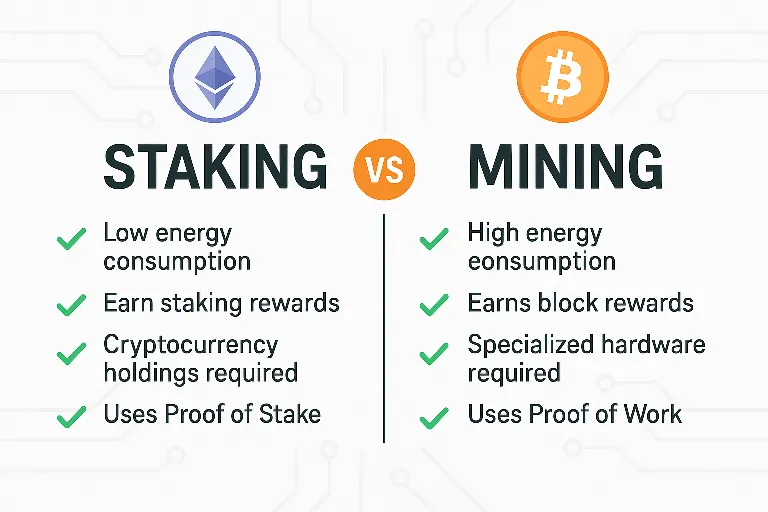
When it comes to earning from crypto currency, the debate of staking vs mining is kind of like choosing between solar power and a diesel generator. Both get the job done, but in very different ways—with varying impacts on cost, energy, and sustainability.
Energy consumption
Let’s start with energy consumption. Crypto mining is notorious for being energy-hungry. Miners use powerful hardware—think of rows of buzzing machines—working 24/7 to solve complex mathematical puzzles. This process, while secure, consumes a ton of electricity. In contrast, crypto staking is the cool, energy-efficient cousin. Since it’s based on the Proof of Stake mechanism, it doesn’t need all that computational firepower. That makes staking an eco-friendly crypto option that aligns with the world’s shift toward sustainability.
Hardware requiremen
Now, on to hardware requirements. Mining demands specialized gear like ASICs or high-end GPUs, which can cost thousands of dollars and need constant maintenance. On the flip side, staking doesn’t require fancy equipment. If you’ve got a stable internet connection and a supported wallet, you’re pretty much good to go. Many staking platforms even let you stake directly from your smartphone.
Reward type
What about the type of rewards? Both methods offer crypto rewards, but how you earn them is different. In mining, you compete to be the first to validate a block—and the winner takes all. In staking, rewards are more predictable. They’re often distributed based on how much and how long you’ve staked, kind of like earning interest from a savings account.
Decentralization, sustainability, and scalability
Let’s not forget the bigger picture—blockchain scalability and decentralization. Mining tends to centralize over time because only those with big money and mega machines can compete profitably. This can limit access and increase control by a few big players. Staking, on the other hand, opens the door to more users participating, especially through staking pools. It’s better suited for blockchain scalability, helping networks grow faster and more efficiently.
In short, if you enjoy the technical thrill and don’t mind high costs and maintenance, mining might suit you. But if you prefer a cleaner, simpler, and more sustainable route to earning crypto rewards, staking could be your ideal pick.
So in the battle of staking vs mining, there’s no one-size-fits-all answer—just the path that fits your goals, resources, and values in the evolving world of crypto currency.
Pros and Cons of Crypto Mining
Crypto mining might sound like the digital version of striking gold, and in many ways, it is. But before you rush to build your own mining rig, it’s important to weigh both the glitter and the grit of the process. Like any money-making method, crypto mining has its ups and downs.
Pros
Let’s start with the bright side. One of the biggest advantages of mining is the potential for high rewards. When you successfully mine a block, you’re not just verifying transactions—you’re also earning freshly minted coins and transaction fees. For example, successful Bitcoin miners can earn significant payouts per block, especially when market prices are high. It’s like being paid to keep the network running.
Another major plus? You’re playing a direct role in blockchain security. Miners are the guardians of the blockchain, making sure every transaction is verified, legitimate, and tamper-proof. If decentralization and data integrity matter to you, mining gives you front-row seats to protect and participate in that process.
But before you get too excited, let’s talk about the not-so-glamorous side of mining.
Cons
First up: expensive hardware. Getting started in mining isn’t cheap. You’ll need specialized equipment like ASICs or high-performance GPUs—and those don’t come with friendly price tags. Plus, this hardware becomes outdated fast, especially as mining difficulty increases.
Then there’s the energy problem. Mining is an energy-intensive crypto activity, often criticized for its environmental impact. Those machines? They run day and night, sucking up electricity like there’s no tomorrow. If you’re not careful, your electricity bill might eat up your entire mining profit.
And don’t forget about technical complexity. Mining isn’t just plug-and-play. It requires knowledge of setting up hardware, joining mining pools, managing cooling systems, and updating software. If tech isn’t your thing, it might feel more like a headache than a hustle.
Lastly, crypto mining risks are real. Price volatility, hardware failures, regulatory changes, and increasing competition can all impact your returns. One month you’re in profit, the next you’re breaking even—or worse.
So, is crypto mining worth it? For some, yes—it’s a passion and a profession. But for others, the costs and complexities might outweigh the benefits. As always in the crypto world, doing your research and calculating your risks is key to making smart moves.
Pros and Cons of Crypto Staking
If mining is like running a power plant, crypto staking is more like planting a money tree and waiting for it to grow. It’s one of the most talked-about ways to earn passive income with crypto—and for good reason. But like everything in the crypto world, staking has both shiny perks and a few prickly pitfalls.
Pros
Let’s start with the sweet stuff—the staking benefits.
First up, it’s super easy to start. No need to buy expensive hardware or set up complicated systems. If you can create a wallet and hit a “stake” button on an exchange or platform, you’re halfway there. Whether you’re staking Ethereum, Cardano, or Solana, the process is beginner-friendly and takes just a few minutes.
Second, it’s energy-efficient—a big win in the age of climate awareness. Unlike mining, staking doesn’t require warehouses full of buzzing machines. The Proof of Stake model is lightweight and eco-conscious, making crypto staking one of the most sustainable ways to earn passive income in blockchain ecosystems.
Third, staking offers predictable rewards. Most staking platforms and networks provide clear estimates of your expected earnings. It’s like earning interest from your bank, only with much higher returns (and way cooler tech behind it).
Cons
But before you get too comfy, let’s talk about the staking risks.
One of the biggest drawbacks is the lock-up period. When you stake your coins, they’re often locked for a specific time. During that period, you can’t sell or move them—even if prices crash or a golden opportunity comes up. It’s like putting your money in a fixed deposit—useful, but not flexible.
Another risk is slashing. Sounds dramatic, right? It is. If the validator you’ve staked with misbehaves or makes errors, part of your staked coins can be slashed (destroyed). While rare, this is a real risk in some networks.
And then there’s the matter of platform trust. If you’re staking through an exchange or third-party service, you’re trusting them with your funds. If the platform faces hacks, mismanagement, or shuts down, your coins could be at risk.
So, is staking worth it? If you’re looking for a low-effort, eco-friendly, and steady way to earn passive income with crypto, it absolutely can be. Just be sure to choose your staking platform wisely, understand the lock-up terms, and never stake more than you can afford to lose.
Which Is More Profitable in 2025?
As we cruise through 2025, one question echoes across every crypto enthusiast’s mind: Which makes more money—staking or mining? The answer isn’t one-size-fits-all, but by looking at current trends and real-world numbers, we can start to connect the dots on crypto profitability in 2025.
First, let’s talk about the broader scene. Crypto currency adoption has gone mainstream. From big banks offering crypto services to governments exploring blockchain-based infrastructure, the demand for decentralized systems has skyrocketed. And with that demand comes more opportunities for earning—especially through staking and mining.
Let’s talk Ethereum 2.0—the poster child for crypto evolution. Ethereum officially moved from Proof of Work to Proof of Stake in one of the biggest transitions in blockchain history. This shift not only slashed energy consumption by over 99% but also signaled the industry’s move toward more sustainable earning models. So, in 2025, Ethereum mining is officially history. Now, Ethereum staking is king—and it’s offering fairly predictable, steady returns, often around 4–6% annually.
On the other side, crypto mining still exists—especially for coins like Bitcoin, Litecoin, and Dogecoin—but it’s become more competitive and capital-intensive. With rising mining difficulty and electricity costs, only those with access to cheap power and industrial-scale setups are seeing strong mining ROI. Individual miners? Many are turning to mining pools or even exiting the space entirely.
Now, when we compare staking vs mining ROI overall, staking is taking the lead for average users in 2025. You don’t need expensive hardware, you don’t have to deal with high electricity bills, and your returns—while modest—are far more stable. Many altcoins now offer 5–15% annual staking rewards, depending on network activity and your staking method.
Mining, meanwhile, still holds strong ROI potential—but only if you’re running a serious operation. Think bulk ASICs, cheap electricity deals, and a dedicated tech team.
In short, crypto profitability in 2025 favors staking for the average investor and mining for the industrial player. If you’re after low-maintenance, eco-friendly, and passive crypto income, staking is the smarter move. But if you’re ready to go big, handle heat and noise, and bet on Bitcoin’s long game—mining might still be your goldmine. Just remember: profits love preparation—so plan your crypto path wisely!
Best Coins for Staking and Mining
In the ever-evolving world of crypto, one of the smartest moves in 2025 is figuring out which coins are actually worth staking or mining. Whether you’re after high returns, long-term value, or just a smoother entry into the game, choosing the right asset—and the right platform—can make all the difference.
Crypto Currency Staking
Let’s start with the best crypto for staking. At the top of the leaderboard is Ethereum, which since its shift to Proof of Stake, has become the gold standard for staking. Thanks to its huge ecosystem and predictable rewards, Ethereum staking remains a favorite among passive earners.
Next up, we have Cardano (ADA). Known for its academic approach and strong community, Cardano offers consistent returns, minimal risk of slashing, and a highly decentralized validator network. It’s perfect if you want reliable passive income without the drama.
Then there’s Solana (SOL)—fast, efficient, and high-performing. Despite past hiccups, Solana continues to attract developers and stakers alike. Its low fees and quick transaction times make it one of the most exciting networks to earn from in 2025.
Crypto Currency Mining
Now, let’s switch gears and talk mining crypto in 2025.
Bitcoin (BTC), the original crypto, is still the king of mining. But it’s no small feat—thanks to its high difficulty and expensive hardware requirements, Bitcoin mining is best left to large-scale miners or serious enthusiasts.
Litecoin (LTC) is often called Bitcoin’s little brother, and for good reason. It’s faster, has lower fees, and is still profitable to mine with mid-range hardware. If you want to dip your toes into mining without going all in, Litecoin is a solid option.
And don’t forget the meme that became a movement—Dogecoin (DOGE). Mining DOGE is fun, light-hearted, and surprisingly profitable when paired with merged mining (like with Litecoin).
Wondering where to get started?
For staking platforms, exchanges like Binance and Kraken offer easy access to dozens of staking options, with flexible lock-up terms and clear rewards. On the mining side, platforms like NiceHash and F2Pool help you mine various coins without building your own setup from scratch.
Whether you’re staking Ethereum on a mobile app or mining Bitcoin in your garage, success lies in choosing the right coin, the right platform, and the right strategy. In 2025, crypto isn’t just a tech trend—it’s a personalized financial journey. So, stake smart. Mine wisely. Earn confidently.
Final Verdict: Staking or Mining?
When it comes to choosing between staking and mining as a crypto investing strategy, the right choice largely depends on your experience level, resources, and long-term goals.
For Beginners: Staking is the Clear Winner
If you’re new to the crypto space, staking is the more beginner-friendly option. It doesn’t require expensive hardware, deep technical knowledge, or high electricity costs. You simply lock up your coins in a wallet or on a trusted platform and earn passive rewards over time. This makes staking an excellent choice for users looking for long-term crypto income with lower upfront costs and risks.
For Advanced Users: Mining Offers Greater Control and Rewards
Mining, on the other hand, is better suited for advanced users with technical expertise and access to affordable electricity. It involves solving complex mathematical problems using powerful machines, which can be both costly and energy-intensive. However, for those who understand how to manage mining rigs efficiently, the rewards can be more substantial over time. Mining also offers more direct participation in the blockchain network, which appeals to crypto purists.
Sustainability and Eco-Friendliness
From a sustainability perspective, staking has the upper hand. It consumes significantly less energy compared to mining, aligning better with global environmental concerns. As more blockchains shift toward Proof of Stake (PoS), staking becomes the more eco-conscious path for investors seeking to align their values with their investments.
Final Thoughts: Choose Based on Your Goals and Resources
If your goal is long-term crypto income with minimal effort and lower risk, staking is the ideal crypto investing strategy. It’s perfect for investors who want to grow their holdings passively while supporting network security. Conversely, if you have the technical skills, financial capacity, and desire for deeper engagement in the crypto ecosystem, mining may offer greater returns—though with higher risk and responsibility.
In summary, staking suits beginners and sustainability-minded investors, while mining is better for tech-savvy individuals aiming for higher potential profits. Whichever path you choose, ensure it aligns with your resources, goals, and risk tolerance to build a sustainable crypto investing journey.
Conclusion
Understanding the differences between staking and mining is essential for anyone serious about building a sustainable and rewarding journey in the world of cryptocurrency. While both methods are valid ways to earn crypto passively, they cater to different types of investors and involve varying levels of risk, effort, and technical know-how.
Staking appeals to those who prefer a simpler, less resource-intensive route. It’s user-friendly, eco-conscious, and ideal for beginners or those who want a hands-off approach to earning rewards. You don’t need a deep technical background or large investment in hardware—just a willingness to commit your crypto for a period of time and support the network. Over time, this can lead to consistent, low-risk income, making it a reliable crypto investing strategy for long-term growth.
Mining, on the other hand, is for those who want to dive deeper. It’s more complex and requires not only a financial commitment to equipment but also an understanding of how blockchain networks operate. However, with greater complexity often comes greater potential rewards. If you’re tech-savvy and ready to invest in the necessary infrastructure, mining can be a fulfilling way to engage more directly in the crypto ecosystem and potentially earn higher returns—albeit with increased operational costs and risk.
The most important takeaway? There’s no one-size-fits-all answer. Your ideal choice depends entirely on your financial goals, risk tolerance, and available resources. If your aim is long-term crypto income with minimal overhead and lower environmental impact, staking is likely your best bet. But if you’re someone who thrives on technical challenges and wants more control over your earning process, mining might be the more exciting path.
Before diving into either method, take time to evaluate what aligns best with your current situation and future plans. Do you want a low-maintenance way to earn from crypto while holding onto your assets? Or are you ready to take on a more active role, managing hardware and power usage for potentially greater rewards?
No matter your choice, the key is understanding the trade-offs and being intentional with your investment approach. Crypto is a rapidly evolving space, and staying informed is just as important as the strategy you choose.
So why wait?
Start earning with cryptocurrency—choose your side: staking or mining!
Related articles
Crypto Staking for BeginnersBeginners
Liquidity Mining : A beginners guide to earn passive income in DeFi
CeFi platforms: How to Earn Passive Income From It
Crypto Lending: One of the Best Passive Income Strategies
HODL: Best Crypto Passive Income Strategies for Beginners


I always used to read piece of writing in news papers but now as I am a user of net so from now I
am using net for content, thanks to web.
That’s wonderful to hear! 😊 The internet truly has made access to information so much easier. I’m glad you found your way here—hope you continue enjoying the content. Thanks for stopping by!
Hi my friend! I want to say that this article is awesome, great written and include
almost all vital infos. I’d like to look more posts like this .
Thank you so much for your kind words! 😊 I’m really glad you found the article informative and well-written. Your support means a lot. Stay tuned—more detailed posts are coming soon!
What’s Taking place i’m new to this, I stumbled upon this I’ve discovered It absolutely useful and it has aided
me out loads. I am hoping to give a contribution & assist different customers like its
aided me. Great job.
Thank you so much for your kind words! 🙌 I’m really glad to hear that the article helped you out. The crypto space can feel overwhelming at first, but once you get the hang of concepts like staking and mining, things start making more sense. Keep exploring and feel free to share your own experiences or questions here—it could help others who are just starting out too. 🚀
Cabinet IQ Fort Myers
7830 Drew Ciir Ste 4, Fort Myers,
FL 33967, United Ѕtates
12394214912
Homeupdates
Hello, i believe that i noticed you visited my web site so i got here to go back the choose?.I’m
trying to in finding things to improve my site!I assume its ok to make use of a few of your ideas!!
Hi! Thanks for stopping by and leaving a comment. I’m glad you found your way here! 😊 Feel free to use any ideas that might help improve your site. Wishing you the best with your website updates!
Wow, wonderful blog layout! How long have you been blogging
for? you make blogging look easy. The overall look of
your website is excellent, as well as the content!
I’m amazed, I have to admit. Rarely do I encounter a blog that’s
both educative and engaging, and let me tell you, you’ve hit the
nail on the head. The issue is something not enough folks are
speaking intelligently about. I’m very happy that I stumbled
across this during my hunt for something relating to
this.
You’ve made some decent points there. I checked on the internet for more information about the issue and found most individuals will go along with your views on this web site.
At this time I am going away to do my breakfast, once having my breakfast coming yet again to read additional news.
Wonderful beat ! I would like to apprentice at the same time as you amend
your site, how can i subscribe for a weblog site?
The account aided me a acceptable deal. I were a little bit familiar of
this your broadcast provided vibrant clear concept
Excellent beat ! I wish to apprentice while you amend your site,
how can i subscribe for a weblog web site? The account helped me a acceptable
deal. I had been tiny bit acquainted of this your broadcast
offered shiny clear idea
Hey! This post could not be written any better!
Reading through this post reminds me of my good old room mate!
He always kept talking about this. I will forward this article to him.
Fairly certain he will have a good read. Thanks for sharing!
I believe this is one of the so much important info for me.
And i’m happy reading your article. But should remark on few common issues, The site taste is ideal, the articles is actually excellent :
D. Just right task, cheers